
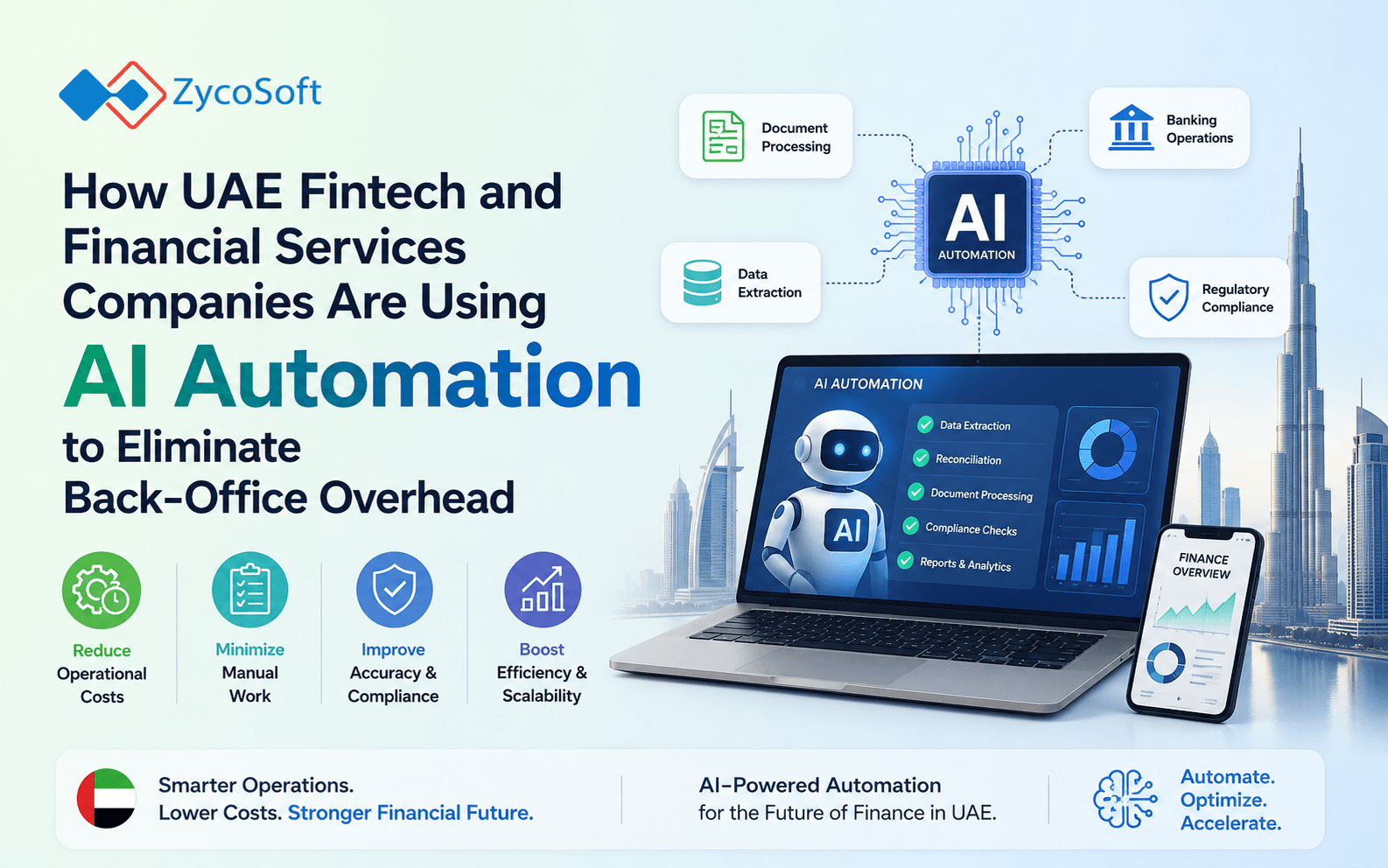
How UAE Fintech and Financial Services Companies Are Using AI Automation to Eliminate Back-Office Overhead
The operations team at a Dubai-based payments fintech had built something genuinely impressive: a multi-currency platform processing transaction across six markets, a growing institutional client base, and a DIFC licence that had taken eighteen months to secure. What they had not built was any automation behind it. Every new client onboarding triggered a chain of manual steps: downloading KYC documents from email, copying data into the CRM, flagging exceptions in a shared spreadsheet, chasing compliance sign-off on WhatsApp. Three operations staff spent the majority of their working week on tasks a well-configured pipeline could handle in minutes.
By the time transaction volumes doubled, the cracks were visible. Reconciliation runs that once took a morning now consumed two full days. Monthly compliance reports were assembled by hand from four different system exports. The Head of Operations knew the team was spending more time managing process than managing risk, but every conversation about fixing it stalled at the same point: who builds this, and how do we know it will hold up under regulatory scrutiny?
This is not an unusual position for a UAE fintech at the scale-up stage. The manual infrastructure that got you through the first phase becomes the ceiling that stops you reaching the next one. The question is not whether to automate, it is which processes to target first, what standards the pipelines need to meet, and what kind of engineering partner can actually deliver them.
Where UAE Fintech Firms Are Deploying AI Automation First
AI automation for UAE fintech back-office operations delivers the fastest returns when applied to high-volume, structured processes where manual handling creates the most friction. Based on production deployments in the financial services sector, four areas consistently produce measurable results within the first quarter of deployment.
- Client onboarding and KYC document processing: Extracting structured data from passports, Emirates IDs, proof of address documents, and corporate registry filings using LLM-based document intelligence, then routing validated records automatically into compliance queues.
- Compliance reporting: Aggregating data from core banking or payments platforms, applying regulatory mapping logic, and generating structured reports in the format required by DIFC, ADGM, or international regulators, without manual export and reformatting cycles.
- Payment reconciliation: Matching transaction records across payment rails, flagging discrepancies automatically, and generating exception reports that only require human review when a rule cannot be resolved programmatically.
- Audit trail and data retention workflows: Automatically tagging, archiving, and scheduling deletion of client data in line with defined retention policies, so compliance obligations are met continuously rather than during a manual quarterly review.
The sequencing matters. Most UAE fintech operations teams that attempt to automate everything simultaneously end up with half-finished pipelines and low adoption. Starting with client onboarding delivers visible wins quickly, builds internal confidence in the approach, and surfaces integration requirements that inform everything built afterwards.
What AI Automation Actually Looks Like Inside a Financial Services Workflow :
Generic descriptions of AI automation rarely help operations leaders make concrete decisions. A production pipeline for UAE fintech back-office work typically involves several distinct components working in sequence.
A workflow orchestration layer, commonly built in n8n for firms that need flexibility without sacrificing auditability, handles the movement of data between systems and the triggering of actions based on defined conditions. On top of that, large language models perform the work that previously required human judgement: extracting specific fields from unstructured documents, classifying transaction types, identifying anomalies in reconciliation data, or drafting compliance narrative sections from structured inputs.
The output is not a black box. Every action the pipeline takes is logged, timestamped, and attributable, which matters enormously in a regulated environment. Understanding the architectural difference between AI agents and traditional workflow automation is important here, because the design decisions made at the start determine whether the pipeline can handle the variability and exception volume that financial services data actually generates in production.
Why Off-the-Shelf Tools Fail at Financial Services Scale :
Point-and-click automation tools work well for simple, linear processes with clean, standardised inputs. Financial services workflows are rarely either. KYC documents arrive in dozens of formats. Transaction records carry inconsistent field naming across payment providers. Compliance rule sets change when regulators update guidance.
Custom AI pipelines built to handle this variability outperform generic tools on three dimensions that matter in regulated environments: accuracy under variable input conditions, auditability of every decision the pipeline makes, and the ability to update rule logic without rebuilding the entire workflow from scratch. A detailed comparison of n8n, Zapier, and Make for business process automation covers this in more depth, but for UAE fintech operations the short answer is that production-grade pipelines require production-grade tooling.
The GDPR Question: Why International Regulatory Exposure Changes the Data Governance Requirement
UAE fintech firms frequently ask whether GDPR applies to them. The technical answer is that GDPR obligations attach to the processing of EU residents' personal data, regardless of where the processing firm is based. A Dubai payments platform with European institutional clients, EU-facing products, or data flows touching EU-regulated counterparties has direct GDPR exposure.
Beyond the legal question, applying GDPR-equivalent data governance principles to AI automation pipelines has become a commercial requirement. European fund managers, institutional investors, and regulated financial intermediaries routinely include data governance provisions in their counterparty due diligence. A UAE fintech that cannot demonstrate data minimisation, access controls, encryption standards, and automated retention management is increasingly at a disadvantage in those conversations.
Building these principles into AI pipelines from the start is substantially less costly than retrofitting them after deployment.
The key elements include:
- Processing only the data fields the pipeline strictly requires for its function, not full document payloads
- Role-based access controls on all pipeline outputs and intermediate data stores
- Encryption in transit and at rest across every data handoff in the workflow
- Automated retention schedules that archive or delete records without requiring manual intervention
- Full audit logging so every pipeline action can be attributed and reviewed
This is an area where the choice of engineering partner matters as much as the choice of technology. Building GDPR-compliant software architecture from day one requires deliberate decisions at every layer of the stack, not a compliance checkbox applied after the build is complete.
What a Realistic Automation Deployment Timeline Looks Like
UAE fintech operations leaders who have been through failed automation projects often describe the same pattern: a vendor promises a fast, low-effort deployment, the initial demo looks compelling, and then the integration reality hits and the project stalls for months.
A realistic timeline for a well-scoped AI automation pipeline targeting one back-office function runs as follows:
- Weeks 1 to 2: Process audit and integration mapping. Document the current manual workflow in full, identify every system that needs to connect, and define the acceptance criteria for a successfully automated output.
- Weeks 3 to 5: Pipeline architecture and build. Design the orchestration logic, configure LLM extraction and classification components, and build integration connectors to core systems.
- Weeks 6 to 7: Testing against real data. Run the pipeline against historical documents and transactions, measure accuracy, and refine extraction logic where variability is causing errors.
- Weeks 8 to 10: Staged deployment and handover. Deploy to production with a parallel manual process running alongside, validate output quality, and transition to full automation once accuracy thresholds are consistently met.
Firms that invest time in the process audit before development starts consistently achieve faster deployment and lower rework rates. The pipelines that fail in production are almost always the ones where the engineering team inherited an incomplete picture of how the manual process actually worked.
How to Choose an Engineering Partner for UAE Fintech AI Automation
AI automation for UAE fintech back-office operations is a specialised capability. The engineering team building these pipelines needs to understand financial services data structures, regulatory audit requirements, and the difference between a demo that works on clean test data and a pipeline that holds up when production documents arrive in six different formats from three different sources.
The questions worth asking any prospective engineering partner include:
- Have they built AI automation pipelines specifically for regulated financial services environments?
- Can they demonstrate production deployments, not proofs of concept?
- Do they apply data governance principles that would satisfy a GDPR audit, even if your primary regulatory framework is DIFC or ADGM?
And do they operate with the communication practices and documentation standards that regulated firms require from their technical partners?
ZycoSoft works as a dedicated team extension for UAE fintech and financial services firms building these pipelines. We design and deploy production AI automation using n8n and large language models, apply GDPR-equivalent data governance from the architecture stage, and operate to Western engineering standards with full documentation, version control, and audit-ready output. We have delivered custom automation pipelines under NDA for clients in financial services and regulated industries where the data handling requirements are non-negotiable.
The Dubai payments fintech from the opening of this post did eventually resolve the problem. Not with a generic automation tool, and not with a six-month procurement cycle. A focused eight-week build targeting onboarding and reconciliation removed the two highest-volume manual processes from the operations team's week entirely. The three staff members who had spent their time copying data between systems moved to exception management and client relationship work instead. Compliance reporting that had taken two days now took forty minutes. The ceiling lifted.
If your operations team is spending time on work that a well-built pipeline should be handling, the first step is a direct conversation about where the friction is. Get in touch with ZycoSoft to discuss what a scoped AI automation engagement for your back-office operations would look like.
Frequently Asked Questions
Most UAE fintech and financial services firms begin with document processing and client onboarding, because these generate the highest manual volume with the most predictable structure. Compliance reporting and payment reconciliation follow closely. These four areas typically account for 60 to 80 percent of repetitive back-office labour in a scaling fintech operation, making them the most immediate targets for AI automation.
AI automation pipelines in UAE fintech typically combine workflow orchestration tools such as n8n with large language models to extract, classify, validate, and route documents or data without human intervention. The pipeline ingests inputs such as KYC documents or transaction records, applies LLM-based extraction and rule-based validation, then pushes structured outputs to core systems. This removes manual handling from the critical path while maintaining a full audit trail.
Formally, GDPR applies to firms processing data belonging to EU residents, not to UAE domestic operations. However, UAE fintech firms with European clients, EU-regulated partners, or international institutional relationships are directly exposed to GDPR obligations. Beyond legal compliance, applying GDPR-equivalent data governance principles, including data minimisation, access controls, and retention policies, is increasingly a commercial requirement when dealing with European counterparties or regulated funds.
Off-the-shelf tools such as Zapier or Make work well for simple, linear workflows with standardised inputs. Custom AI pipelines built with n8n and LLMs handle unstructured data, variable document formats, multi-step conditional logic, and high transaction volumes that generic tools cannot manage reliably. For UAE fintech firms processing complex KYC packs, multi-currency reconciliation, or regulatory submissions, custom pipelines deliver the accuracy and auditability that off-the-shelf tools cannot sustain at scale.
A focused AI automation pipeline targeting one back-office function, such as client onboarding document processing or compliance report generation, can typically be scoped, built, and deployed in six to ten weeks with a dedicated engineering team. The timeline depends on the complexity of existing systems, the quality of data inputs, and the number of integration points. Firms that invest in clear process mapping before development begins consistently achieve faster deployment and lower rework rates.
UAE fintech firms should apply data minimisation principles, ensuring pipelines only process and retain data strictly necessary for the function. Access controls must be role-based and logged. Data in transit and at rest must be encrypted. Retention schedules should be automated and auditable. For firms with international exposure, aligning these practices with GDPR-equivalent standards is not optional; it is a prerequisite for maintaining relationships with EU-regulated counterparties and institutional clients.