
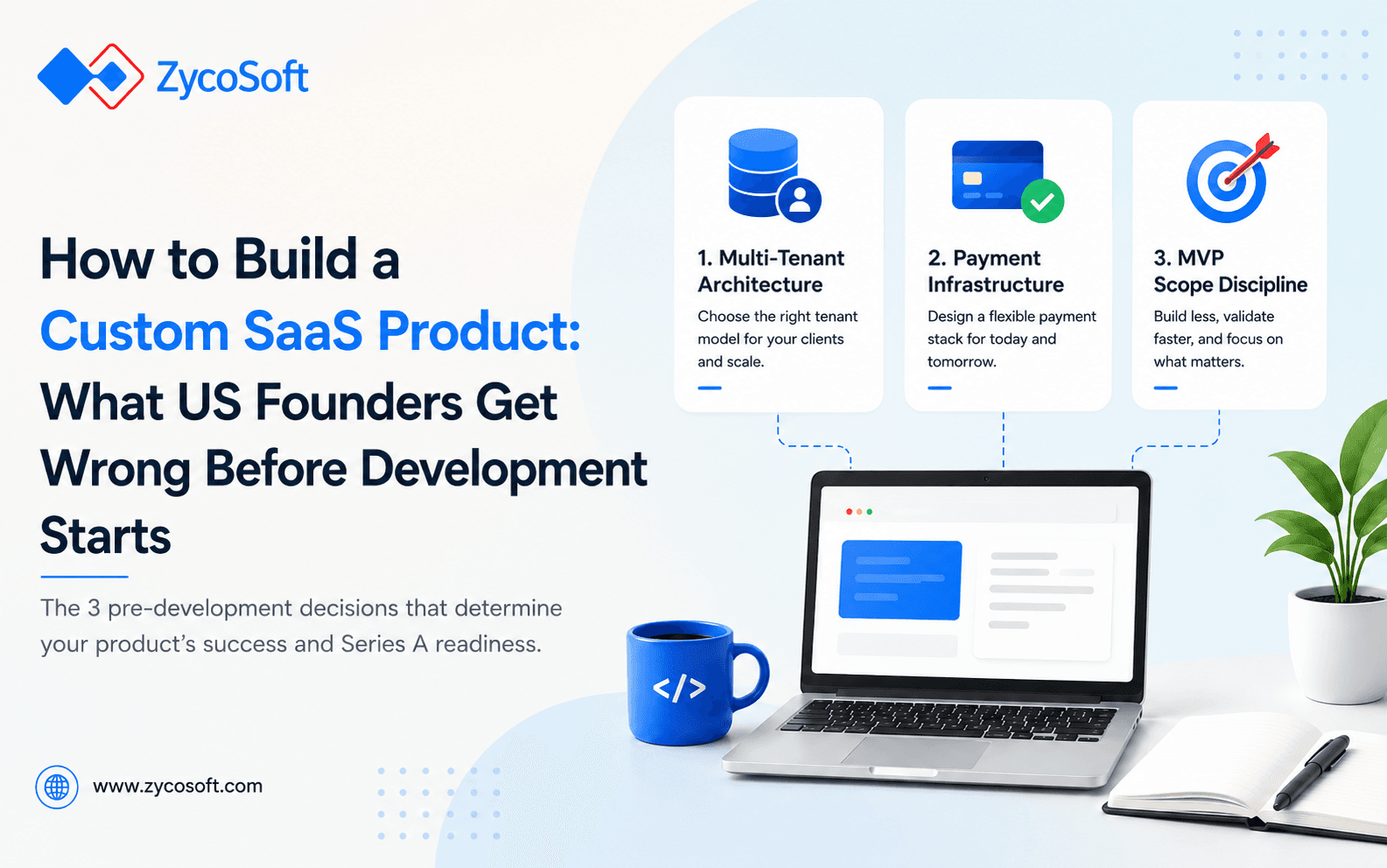
How to Build a Custom SaaS Product: What US Founders Get Wrong Before Development Starts
The founder had a working Figma prototype, a signed letter of intent from two pilot clients, and a $600,000 pre-seed round sitting in the bank. She hired a four-person freelance team in week three and told them to start building. Eleven months later, with $480,000 spent, she had a product that her first enterprise prospect could not use because all client data lived in a shared schema. Separating it would mean rebuilding the data layer from scratch.
This is not an unusual story. The details change, but the shape of it is consistent across dozens of early-stage US B2B SaaS companies. The founding team moves fast, which is the right instinct, but fast in the wrong direction. Three foundational decisions get deferred because they feel like engineering concerns rather than founder concerns. By the time they surface, they surface as invoices.
What follows is a breakdown of exactly those three decisions, framed around what a structured remote engineering partner forces you to resolve before a single line of application code is written. If you are preparing to build or rebuild a B2B SaaS product, this is the conversation you need to have before you sign any development contract.
Why Pre-Development Decisions Determine Series A Readiness
Technical due diligence at Series A is more rigorous than most early-stage founders expect. Investors bring in engineers to review architecture, data models, and payment infrastructure. What gets flagged is rarely buggy code. It is structural decisions that made sense at speed but do not hold up at scale.
The three decisions that appear most frequently in those audit reports are multi-tenant architecture, payment infrastructure, and MVP scope discipline. None of them require a CTO to resolve. They require a structured pre-development process, the kind that a disciplined remote engineering partner runs as standard before any sprint planning begins.
Skipping that process does not save time. It borrows time from your Series A preparation and repays it at a punishing rate.
Multi-Tenant Architecture: The Decision That Looks Simple and Is Not
Multi-tenant architecture determines how your application stores and separates data across clients. There are three principal models, and choosing between them is one of the most consequential decisions in custom SaaS development.
- Shared database, shared schema: All tenants share the same tables, distinguished by a tenant ID column. Cheapest to build and operate at small scale. Breaks down when enterprise clients require data isolation for compliance or security reasons.
- Shared database, separate schemas: Each tenant gets its own schema within a shared database instance. Moderate operational cost, reasonable isolation. Works well for mid-market B2B products where clients want logical separation but full database isolation is not a contractual requirement.
- Separate database per tenant: Full isolation, highest operational complexity and cost. Required by regulated industries including healthcare, legal, and financial services. Often demanded in enterprise contracts by clients with their own information security policies.
The founder in our opening scenario built on shared schema because it was the fastest model to implement. Her pilot clients were small enough that it did not matter. Her first enterprise prospect, a 3,000-seat legal technology buyer, needed separate databases as a contractual condition of purchase. The rebuild took fourteen weeks and cost roughly $90,000 in engineering time alone.
The right model depends on your target client profile, your compliance exposure, and your growth trajectory. A good custom SaaS development agency will not ask you which model you want. It will ask you who your clients are, what sectors they operate in, and what your contract terms are likely to look like at Series A. The architecture decision follows from those answers.
Payment Infrastructure: Stripe-First Is Not Always the Right Answer
Stripe is the default choice for US SaaS companies, and for good reason. It handles subscription billing cleanly, supports usage-based pricing models, and offers Stripe Connect for marketplace and platform payment flows. For a US-only B2B SaaS product targeting domestic clients, Stripe-first is usually the correct call.
The problem emerges when founders design for Stripe-only and then discover that a significant portion of their addressable market sits outside Stripe's optimal coverage. Expansion into EU markets, for example, may benefit from a hybrid stack that incorporates providers such as Mollie alongside Stripe. Founders who have hardcoded Stripe assumptions into their billing logic face a partial rebuild every time they enter a new region.
What to Decide Before Your First Payment Integration
Before writing any billing code, resolve the following:
- Which geographies will you serve at launch, and which will you enter within 24 months?
- Will your pricing model be flat subscription, seat-based, usage-based, or a hybrid?
- Do you need marketplace-style payment splitting (Stripe Connect) from day one, or is that a later-stage requirement?
- Are any of your target clients in regulated sectors that restrict payment processor choice?
Answering these questions takes a single working session. Not answering them and allowing the development team to default to whatever they know best is how payment infrastructure becomes a rebuild project eighteen months into your product lifecycle. A rigorous partner in custom SaaS product development will run this session before any sprint is scoped. Scoping the full project correctly depends on having these answers in hand first.
MVP Scope Discipline: The Feature You Build Last Should Not Be Built at All
The most consistent pattern in failed or delayed SaaS MVP builds is a scope that reflects the product vision rather than the validation hypothesis. Founders know what they want to build. The MVP should answer a much narrower question: does this specific workflow solve a real problem for a defined user, well enough that they will pay for it?
Every feature beyond that answer is risk, not value. It delays launch, absorbs engineering budget, and often gets cut after the first round of user feedback anyway. The technical debt it creates is real, but the opportunity cost is worse. Three months of unnecessary feature development is three months of market feedback you did not collect.
A Practical Scope Reduction Test
For each feature on your proposed MVP list, ask three questions:
- Can a pilot client prove value from the product without this feature?
- Would removing this feature change what the product proves about our hypothesis?
- Is this feature here because users need it, or because it looks good in a demo?
If a feature survives all three questions, it belongs in the MVP. If it fails any one of them, it belongs in version two. A disciplined MVP development partner will challenge your feature list before accepting it. That challenge is not friction. It is the most valuable thing they do in the pre-development phase. Planning your project properly before hiring developers is where scope discipline is either built in or permanently absent.
What a Structured Pre-Development Process Actually Looks Like
A structured pre-development engagement with a capable custom SaaS development agency covers all three of the above decisions systematically, before any sprint is planned or any code is written. The output is not a proposal. It is a set of binding architectural decisions that the entire build is grounded in.
In practice, that means a discovery phase of one to two weeks covering tenant model selection, payment infrastructure mapping, and a scope validation workshop where features are challenged against the validation hypothesis. The founder comes out of that process with a technical brief that a Series A engineer can review without finding structural surprises.
For US founders considering a remote engineering partner, the time zone gap is manageable and the structured process more than compensates for it. What matters is not geography. It is whether the partner has the discipline to slow you down for two weeks so that the following sixteen weeks build the right thing. US startups working with extended remote product teams consistently report that the pre-development alignment phase is where the real value is delivered.
Build the Right Product, Not Just a Fast One
The founder from our opening scenario eventually rebuilt her data layer, closed her enterprise deal, and went on to raise a Series A. But she did it eight months later than her original plan, with $90,000 less in the bank, and with a technical narrative in her investor deck that required explanation. The rebuild was survivable. It was also entirely avoidable.
If you are preparing to engage a custom SaaS development agency in the UK or a remote engineering partner anywhere, the most important question to ask is not how fast they can start. It is what decisions they require you to make before they do. The answer to that question tells you everything about the quality of what you are about to build.
If you are at the stage where those decisions are still open, that is exactly where the conversation should begin. Talk to ZycoSoft and let us run the pre-development process that resolves them properly before development starts.
Frequently Asked Questions
Before hiring any development team, a US SaaS founder should resolve three foundational decisions: which multi-tenant architecture model suits their client base, which payment infrastructure stack they will build around (Stripe-first or hybrid), and what the MVP scope actually is. Skipping these decisions means the team builds toward assumptions that often break at Series A scale, triggering expensive rebuilds.
Multi-tenant architecture determines how your application separates customer data. The three main models are shared database with shared schema, shared database with separate schemas, and separate databases per tenant. The right choice depends on your compliance requirements, your target client size, and your expected growth rate. Choosing the wrong model at the start often means a full data layer rewrite when an enterprise client requests isolation.
Stripe is the default choice for US SaaS companies and is well-suited to subscription billing, usage-based pricing, and marketplace payments via Stripe Connect. However, founders planning to expand internationally or serve clients in markets where Stripe has limited coverage should design a hybrid payment infrastructure from the start, incorporating providers such as Mollie for EU clients or Razorpay for South Asian markets, rather than retrofitting later.
The most common mistake is building a feature set that reflects investor pitch slides rather than the single workflow that proves the product hypothesis. A well-scoped MVP contains exactly enough functionality to validate whether the core problem is solved for a defined user segment. Every feature beyond that delays launch, burns runway, and often gets removed after the first round of user feedback anyway.
A custom SaaS development agency brings a structured pre-development process, including architecture review, payment infrastructure planning, and scope validation, before any code is written. Freelance teams typically begin where the brief ends, which means foundational decisions get made implicitly during development rather than explicitly before it. For US founders building B2B SaaS, that distinction is the difference between a clean Series A technical audit and an expensive rebuild.
A well-scoped B2B SaaS MVP typically takes between 10 and 16 weeks with a focused remote engineering partner, assuming architecture decisions and scope are resolved before development begins. Founders who arrive without those decisions settled add four to eight weeks of discovery and rework before any productive development starts. The pre-development phase is not overhead; it is where the timeline is won or lost.