
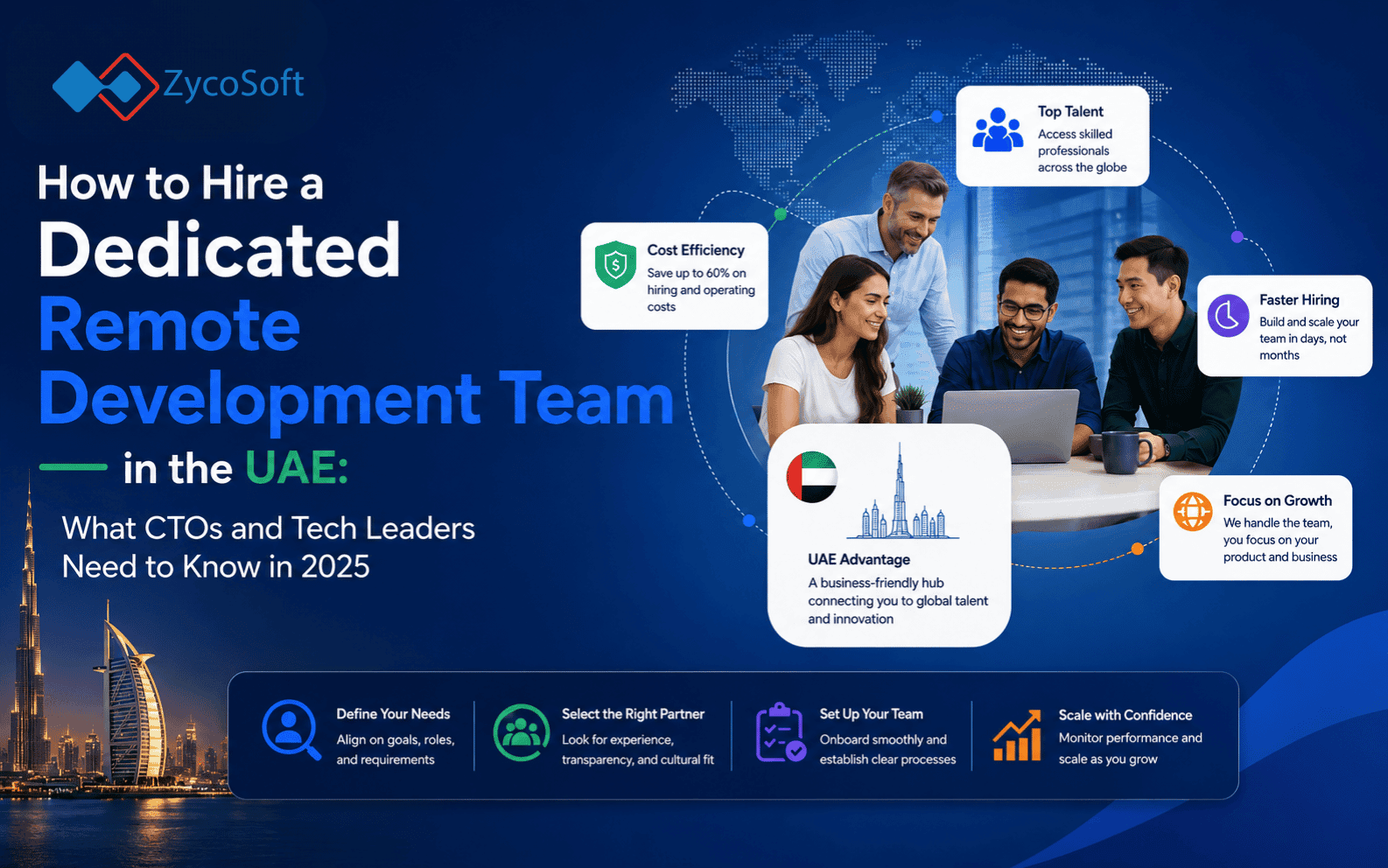
How to Hire a Dedicated Remote Development Team in the UAE: What CTOs and Tech Leaders Need to Know in 2025
Most UAE tech leaders arrive at the same decision point by the same route: an engineering bottleneck, a board mandate to ship faster, and a shortlist that includes local recruitment, a Dubai-based agency, and a dedicated remote development team UAE partners are increasingly positioning as a fourth option. The problem is that each path looks deceptively similar in a pitch deck and wildly different in practice six months into delivery.
This guide is structured for CTOs and VP Engineering at fintech, proptech, and logistics scale-ups who need to make this decision with accurate inputs, not vendor promises.
What In-House Engineering Actually Costs in Dubai and Abu Dhabi
The headline salary is not the number that matters. In Dubai and Abu Dhabi, the fully loaded cost of a single senior engineer is substantially higher than the base figure, and most hiring plans underestimate it by 30 to 40 per cent before the first line of code is written.
The Real Cost Structure
For a senior software engineer hired directly in Dubai in 2025, a realistic cost breakdown looks like this:
- Base salary: AED 25,000 to AED 45,000 per month, depending on stack and specialism
- Visa and Emirates ID processing: AED 5,000 to AED 8,000 per hire
- Health insurance: AED 8,000 to AED 15,000 per year, more for comprehensive plans
- Housing allowance: AED 40,000 to AED 80,000 per year in Dubai, lower in Abu Dhabi
- Annual return flights: AED 5,000 to AED 12,000 depending on home country
- End-of-service gratuity: Accrued at 21 days' salary per year of service
- Recruiter fees: 15 to 20 per cent of first-year salary for specialist technical roles
At the upper end, a single senior engineer costs AED 600,000 to AED 720,000 per year in total. A team of five engineers, a tech lead, and a QA specialist can reach AED 4.5 million annually before office space, equipment, and licence costs are factored in.
For a scale-up that needs to move fast and preserve runway, this is a material strategic constraint. The embedded team extension model exists precisely because the in-house cost structure in the UAE makes it financially irrational to hire locally for every engineering function.
The Operational Risks of UAE Local Vendor Dependency
Local Dubai agencies and regional technology vendors are the default choice for many UAE businesses, and they solve an immediate problem: proximity, Arabic language support, and familiarity with regional procurement processes. But for a product organisation that needs to scale an engineering capability rather than complete a one-off project, the risks are significant and underreported.
What Goes Wrong With the Project-Vendor Model
The structural problem with most local vendor relationships is that accountability ends at delivery. Once a project is signed off, the vendor moves on to the next engagement. Your team inherits a codebase they did not build, documentation they did not write, and a dependency on a vendor who now has limited incentive to support ongoing iteration.
Three specific failure modes appear repeatedly in UAE fintech and proptech scale-ups:
- Knowledge concentration risk: The vendor's lead engineer holds all context. If that person leaves or is reassigned, your team loses institutional knowledge overnight.
- Scope creep and change order inflation: Fixed-price project contracts in the UAE routinely result in 30 to 50 per cent cost overruns through legitimate but avoidable change requests that a genuine embedded team would have flagged during sprint planning.
- Delivery incompatibility: Project-based vendors optimise for handover, not for your product roadmap. Their definition of done rarely aligns with what your CTO means by production-ready.
A genuine remote engineering partner versus a traditional vendor relationship is not a subtle distinction. It changes who holds accountability, how decisions get made, and whether your engineering capacity compounds over time or resets with each contract.
DIFC and ADGM Compliance Expectations for Software Vendors
Fintech and financial services companies operating within the Dubai International Financial Centre or Abu Dhabi Global Market free zones face a specific compliance environment that most technology vendors, local or remote, are not prepared to navigate correctly.
DIFC operates under its own data protection law (DIFC Law No. 5 of 2020), which is substantively aligned with GDPR in its requirements for data processing agreements, data subject rights, and cross-border transfer controls. ADGM applies the ADGM Data Protection Regulations 2021, equally GDPR-equivalent in scope. Any software vendor processing personal data on behalf of a DIFC or ADGM-regulated entity is acting as a data processor and must be able to demonstrate .
- A signed Data Processing Agreement with clearly defined processing purposes and lawful bases .
- Technical and organisational measures proportionate to the risk, including access controls, encryption, and audit logging .
- A documented process for data subject rights requests (access, erasure, portability)
- Clarity on where data is stored, processed, and whether any subprocessors are engaged
- An incident response and breach notification procedure that meets the 72-hour reporting window .
Most UAE local vendors have not built these capabilities into their standard engagement model. A dedicated remote development team UAE companies should be evaluating must be able to produce this documentation before a contract is signed, not after a compliance audit has already been triggered. GDPR-compliant engineering capability remains genuinely rare in the agency market, and in a DIFC or ADGM context, it is not optional.
Timezone and Delivery Compatibility: What Western-Standard Teams Actually Deliver
Timezone is cited as a risk in every evaluation of remote engineering. In practice, it is only a risk when the partner has not structured their team to manage it. For UAE scale-ups, the relevant question is not whether a team is in a different timezone, but whether they operate on Western work practices with structured async communication and defined overlap windows.
The most effective embedded teams for UAE clients operate in a UTC+1 to UTC+3 range, which gives a natural two to four hour overlap with Gulf Standard Time in the late afternoon. This is sufficient for live sprint reviews, architecture decisions, and escalation calls without requiring either side to work outside normal hours.
What Structured Delivery Actually Looks Like
A genuine dedicated team extension does not require you to adapt your product workflow to theirs. The delivery model should include:
- Daily async standup updates delivered to your team before your working day begins
- Sprint ceremonies (planning, review, retrospective) scheduled in the overlap window
- Direct access to engineers in your product management tool, not mediated through an account manager
- Technical accountability held by a named lead engineer, not rotated across a resource pool
- Shared OKRs aligned to your product roadmap, reviewed each sprint
If a prospective partner cannot describe their delivery model in these terms, they are selling you a staffing arrangement, not a team extension. The distinction matters operationally and financially.
What to Actually Evaluate Before Signing a Dedicated Team Agreement
UAE CTOs evaluating a dedicated remote development team UAE partner in 2025 are making a structural decision about how their engineering organisation will function for the next two to three years. The evaluation criteria should reflect that.
Before committing, the following questions should produce specific, evidenced answers from any prospective partner:
- Sector depth: Have they built production systems in fintech, proptech, or logistics? Can they demonstrate it with specific technical examples, not generic case study language?
- Team continuity model: What happens when an engineer leaves? Is there a documented handover process and a bench to draw from?
- Compliance posture: Do they have a standard Data Processing Agreement? Can they describe their access control and audit logging practices without prompting?
- Technical standards: What is their approach to code review, CI/CD, test coverage, and documentation? Ask to see a sample or a reference from a current client.
- Commercial model: Are they billing per deliverable or per sprint? The former is a project vendor. The latter is a team extension.
If you are building a payment-enabled product or a data-intensive fintech platform, also evaluate their experience with payment integration at a technical level. Payment gateway architecture decisions have long-term implications for compliance and scalability that a general-purpose vendor will not flag until they become problems.
For UAE fintech teams exploring how AI automation integrates into a scaled engineering function, the operational considerations around AI automation in UAE fintech back-office workflows are directly relevant to how you structure your embedded team's technical scope.
The embedded team model is not a compromise between in-house and vendor. For UAE scale-ups with constrained hiring budgets, compliance obligations, and genuine product ambitions, it is frequently the only model that delivers sustained engineering velocity without the operational fragility of project-based dependency.
If you are at the evaluation stage and want a direct conversation about how a dedicated team extension would work for your specific engineering context, speak to ZycoSoft.
Frequently Asked Questions
A senior software engineer in Dubai commands a base salary of AED 25,000 to AED 45,000 per month, depending on specialism. Add visa costs, health insurance, housing allowance, annual flights, and end-of-service gratuity, and the fully loaded annual cost per engineer typically reaches AED 480,000 to AED 720,000. That figure excludes recruiter fees, onboarding time, and the productivity ramp period.
A traditional vendor delivers a scoped project and moves on. A dedicated remote development team embeds into your product organisation, attends your standups, follows your engineering standards, and scales up or down with your roadmap. The embedded team model gives you continuity of knowledge and direct accountability to your CTO, not to a vendor's project manager.
DIFC and ADGM do not publish a formal vendor certification list, but regulated entities operating within these free zones are expected to apply data handling, access control, and security standards to all technology suppliers. This includes requiring vendors to demonstrate GDPR-equivalent data protection practices, documented incident response procedures, and clarity on where customer data is processed and stored.
The most effective remote engineering partners for UAE teams operate on a Western work practices model with a UTC+4 to UTC+5 window overlap in the late afternoon. Teams structured this way can deliver daily async updates by UAE morning, attend live architecture or sprint reviews during UAE working hours, and escalate blockers the same day without a 24-hour lag.
Ask specifically: How is the team structured and who holds technical accountability? What happens if a key engineer leaves? Can you demonstrate previous work in fintech, proptech, or regulated sectors? What are your data handling and access control policies? How do you manage sprint ceremonies across timezones? And critically: are you billing per project or embedding as a team extension with shared OKRs?
Yes, provided the partner can demonstrate appropriate data governance, security practices, and contractual accountability. UAE fintech companies operating under DIFC oversight should insist on a signed data processing agreement, documented access controls, and clear policies on subprocessing before any code is written. A capable embedded team will have these in place before you ask.