
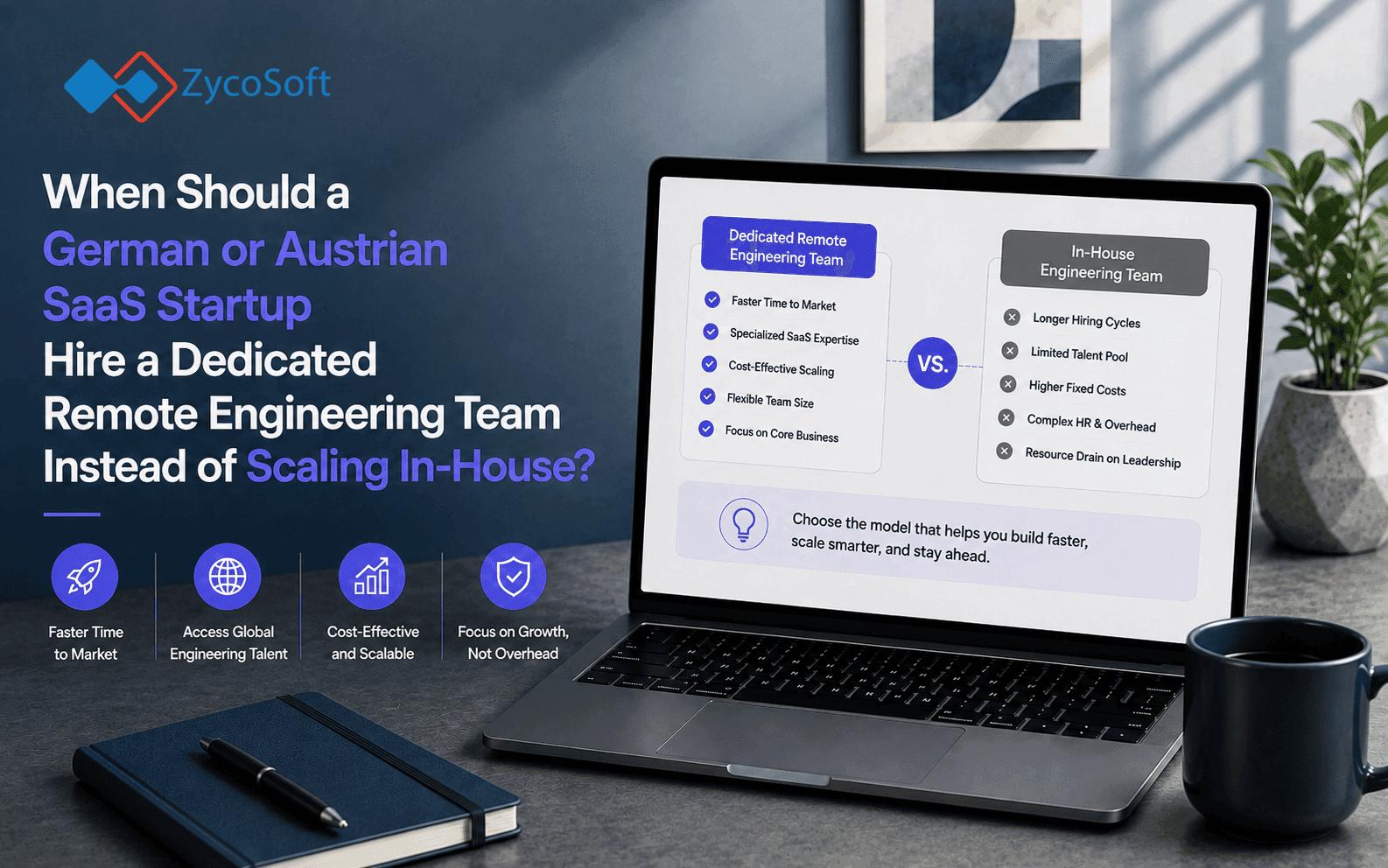
When Should a German or Austrian SaaS Startup Hire a Dedicated Remote Engineering Team Instead of Scaling In-House?
Hiring a senior software engineer in Berlin costs more than 90,000 EUR annually before employer social contributions, which add a further 20 to 25 percent on top. In Vienna, the figure is comparable. Add a three-month notice period on both sides, a hiring cycle that routinely runs 8 to 12 weeks, and a talent pool that is structurally undersized relative to demand, and the standard advice of "just hire" becomes genuinely expensive to follow. This is the build-vs-hire inflection point that German and Austrian SaaS founders face differently from their US or UK counterparts, and it requires a framework specific to the DACH market.
Why the DACH Market Creates a Different Inflection Point
The decision between scaling an in-house team and engaging a dedicated remote engineering team is not purely a cost calculation. In Germany and Austria, several structural factors combine to make in-house scaling slower and more expensive than founders typically model at the early growth stage.
German employment law provides strong protections for employees, including statutory notice periods of up to three months at senior levels, complex redundancy provisions, and works council obligations in companies above certain headcount thresholds. This means that hiring is a long-term financial commitment with limited flexibility, not a variable cost you can adjust quickly if growth plans shift.
The result is that DACH SaaS founders often reach a point where they need 4 to 6 additional engineers within a six-month window but cannot move fast enough through local hiring to meet that demand without stalling the product roadmap. That specific combination, speed of need versus speed of supply, is the clearest signal that a dedicated team extension deserves serious evaluation.
The Real Cost Threshold: What the Numbers Actually Show
A fully-loaded senior engineer in Berlin or Munich costs approximately 110,000 to 130,000 EUR annually when you include salary, employer social contributions, equipment, desk space, and recruitment fees. For a team of four additional engineers, that figure reaches 440,000 to 520,000 EUR per year before any management overhead is accounted for.
A structured dedicated remote engineering team covering the same four roles, with a qualified technical lead, consistent sprint cadence, and embedded team practices, typically runs at 40 to 60 percent of that total cost for comparable experience levels. The saving is real, but it is not the primary reason most DACH founders choose this model. The primary reason is speed and sustained delivery capacity.
When the Numbers Justify Each Model
- In-house hiring makes sense when you need one or two engineers, have 12 or more weeks of runway before you need them productive, and the role involves sensitive stakeholder relationships or co-location requirements that cannot be handled remotely.
- A dedicated team extension makes sense when you need three or more engineers within a 6-to-10-week window, the work stream is product development rather than sales-adjacent, and you need sustained delivery over 12 months or more rather than a single scoped project.
- A scoped project engagement makes sense for pre-revenue founders or those with a defined, time-bounded deliverable such as an MVP build, where a full embedded team is not yet justified by scope or budget.
The dedicated team model is not appropriate below a certain stage. If your product has no paying customers and no validated roadmap beyond the next 90 days, a scoped build is the right structure. Building and launching an MVP in 6 to 12 weeks with a focused external partner is a more disciplined starting point than standing up a full remote team pod prematurely.
GDPR Engineering Obligations Are Not Optional and Most Remote Partners Cannot Meet Them
This is where the DACH market diverges most sharply from US and UK equivalents. German and Austrian SaaS companies operate under some of the most strictly enforced data protection regimes in the EU. The Bundesdatenschutzgesetz (BDSG) supplements GDPR with additional requirements, and German supervisory authorities have demonstrated a willingness to investigate and fine companies for technical non-compliance, not just policy failures.
Any remote engineering partner working on your product must be able to meet a specific set of obligations, not just sign a standard terms of service and claim "GDPR-compliant." The criteria that matter are:
- A signed Data Processing Agreement (DPA) compliant with GDPR Article 28, with specific sub-processor controls
- Demonstrated data residency options within the EU or EEA, not only a promise to avoid US-based servers
- Engineers who understand privacy-by-design at the architecture level, including data minimisation, purpose limitation, and audit logging
- Documented processes for right-to-erasure requests and data subject access requests that can be implemented within the product
- The ability to support a technical audit if required by a German or Austrian supervisory authority
GDPR-compliant software development at the architecture level is genuinely rare among remote engineering partners. Most offer compliance assurances at the policy layer but lack the engineering depth to implement it correctly inside the product. For DACH founders, this is a non-negotiable selection criterion. Understanding what GDPR-compliant software architecture actually requires at the engineering level before you begin partner selection will save significant remediation cost later.
Communication and Cultural Fit: What DACH Founders Consistently Underestimate
German and Austrian professional culture values precision, written documentation, clear accountability, and direct communication. Ambiguity in a sprint brief is not treated as something to work around; it is treated as an error to be raised immediately. This is a strength in engineering contexts, but it creates friction with remote partners who operate on looser, more assumption-heavy communication norms.
When evaluating a remote engineering partner, DACH founders should assess the following criteria specifically:
- Time zone overlap. Central European Time requires a partner with at least 4 to 5 hours of working-hours overlap per day. Partners operating primarily in time zones more than 5 hours behind CET create asynchronous bottlenecks that slow decision-making on DACH product teams.
- Documentation discipline. Ask to see examples of sprint retrospectives, technical decision records, and onboarding documentation from previous engagements. A partner who cannot produce these is not operating at the level a DACH SaaS team requires.
- EU client experience. A partner whose existing client base is predominantly US-based will have calibrated their communication style, availability patterns, and working practices to US norms. That is a different cultural context from what a German or Austrian product team expects.
- Escalation clarity. German and Austrian founders need to know exactly who owns what, and what the escalation path is when something goes wrong. Vague account management structures are not acceptable.
The dedicated team model works best for DACH founders when the remote partner functions as a true team extension: attending the same standups, using the same project management tools, and operating under the same sprint governance as the in-house team. This is structurally different from project-based engagement, and the distinction matters when evaluating partners. European founders working with a remote engineering partner for the first time frequently underestimate how much of the relationship's success depends on communication structure rather than technical capability alone.
The Decision Checklist: How to Determine Your Path
Use the following criteria to identify which model fits your current situation. The more items in column A apply to you, the stronger the case for a dedicated remote engineering team. The more items in column B apply, the stronger the case for in-house hiring.
Signals That Point Toward a Dedicated Remote Engineering Team
- You need 3 or more engineers productive within 10 weeks
- Your local hiring pipeline is running 8 weeks or longer per role
- Your roadmap extends 12 months or more with defined work streams
- You are spending more than 15 percent of CTO time on recruitment
- Your product requires GDPR-compliant architecture built in from the start
- You have paying customers and a validated product but insufficient engineering capacity to ship the next stage
Signals That Point Toward In-House Hiring
- You need one or two engineers and have 12-plus weeks before they must be productive
- The role involves direct enterprise customer relationships or on-site delivery
- Your product is at pre-revenue stage and scope is not yet stable enough to sustain an embedded team
- Your leadership team has not yet established a sprint cadence or documentation discipline that a remote team can plug into
Most DACH SaaS companies at Series A or beyond find that a hybrid model serves them best: a small senior in-house team that owns architecture, product direction, and stakeholder relationships, supported by a dedicated remote engineering team handling sustained feature development, testing, and infrastructure. This structure keeps local headcount manageable under German employment law while maintaining the delivery velocity that growth-stage products require.
If you are at the inflection point and want a clear-eyed view of which model fits your current stage, speak directly with the ZycoSoft team. We work with DACH-region SaaS founders as a dedicated engineering partner, not as a generic supplier, and we can tell you within the first conversation whether the model is the right fit for where you are now.
Frequently Asked Questions
The clearest trigger is when your next senior hire in Berlin or Munich would cost more than 90,000 EUR annually in salary alone, your hiring pipeline is running 8 weeks or longer, and you need more than two additional engineers within the next quarter. At that point, a dedicated remote engineering team delivers faster time-to-productivity at 40 to 60 percent lower total cost, without compromising on delivery quality or GDPR obligations.
Any remote engineering partner working with a German or Austrian SaaS company must operate under a signed Data Processing Agreement compliant with GDPR Article 28, demonstrate data residency options within the EU or EEA, have engineers trained in privacy-by-design principles, and be able to support audit logging, data minimisation, and right-to-erasure workflows at the architecture level. Generic data handling assurances are not sufficient.
Germany and Austria have a smaller pool of senior SaaS engineers relative to demand, longer notice periods (typically three months), higher employer social contribution costs, and stronger employee protection regulations that make rapid scaling or reduction more complex than in US or UK markets. These structural factors mean that in-house scaling carries more lead time and financial commitment than founders often anticipate at the seed or Series A stage.
The dedicated team model becomes worth evaluating seriously when your product team has between 3 and 8 engineers in-house, you are approaching a growth phase requiring 4 or more additional engineers within six months, and your roadmap includes work streams that do not need to be co-located. Below that threshold, a single embedded hire or a scoped build engagement is often more appropriate than standing up a full remote team pod.
DACH founders should look for partners who operate in compatible time zones or with significant overlap (Central European Time plus or minus three hours), follow structured sprint cadences with written documentation, and have demonstrated experience working with EU-based product teams rather than only US or UK clients. Direct, precise communication styles that match German and Austrian professional norms matter more than founders often expect when choosing a remote engineering partner.
Generally not at the pre-revenue stage. A full dedicated remote engineering team is optimised for sustained product development over 6 to 24 months and requires sufficient scope to justify the model. Pre-revenue or early MVP-stage founders are better served by a scoped MVP engagement with a fixed deliverable. The dedicated team extension model becomes appropriate once there is a defined product, paying customers, and a roadmap extending beyond the next 90 days.