
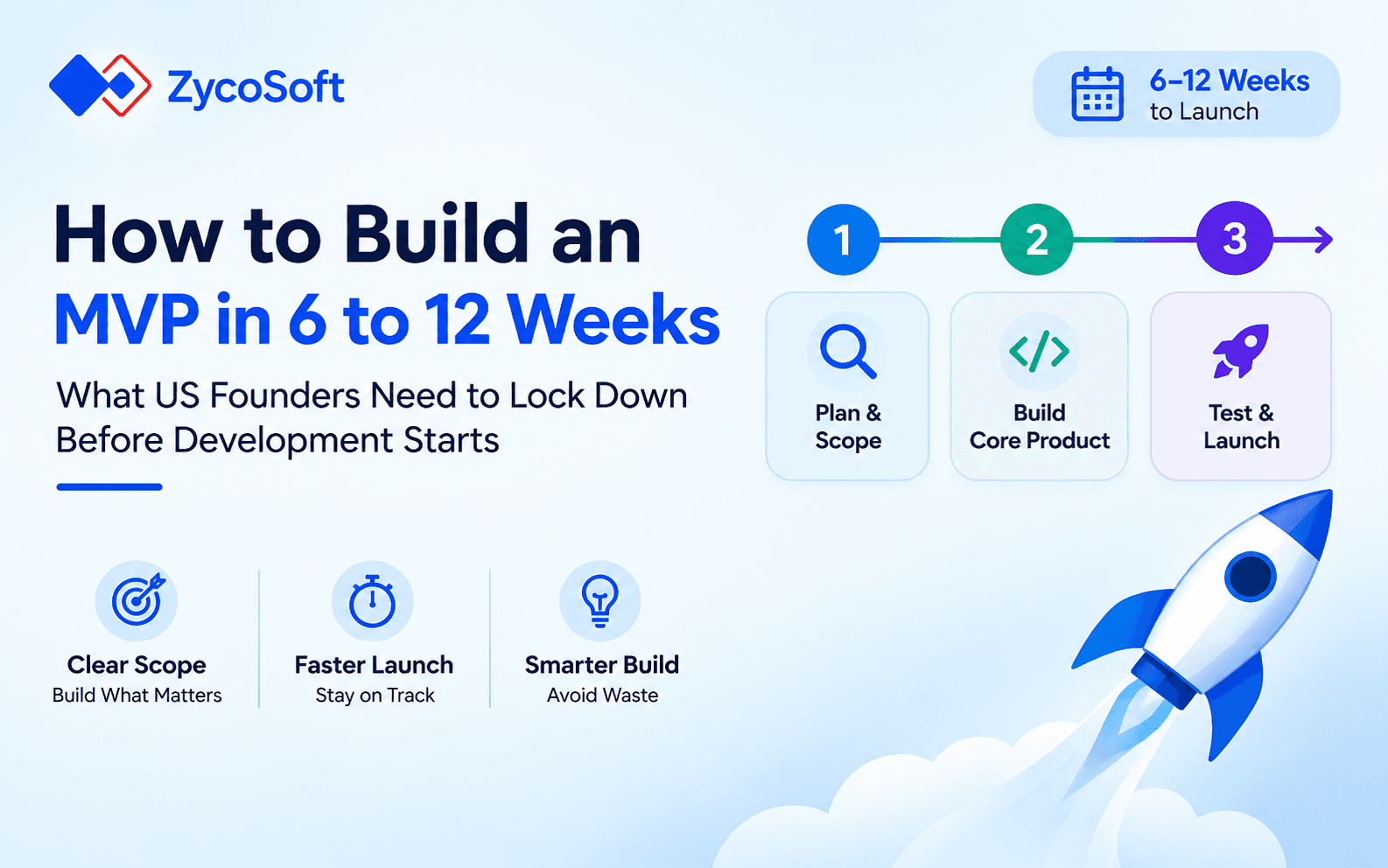
How to Build an MVP in 6 to 12 Weeks: What US Founders Need to Lock Down Before Development Starts .
A founder in Austin had spent four months talking to developers. Three agencies had sent proposals. Two freelancers had started work and stalled. The product idea was solid, the problem was real, and early conversations with potential users had been encouraging. But every development conversation ended the same way: a growing feature list, a ballooning estimate, and a timeline that kept moving from "next quarter" to "end of year."
By the time she reached out to a dedicated remote engineering partner, her original ten-week build had been scoped into a fourteen-month roadmap. Nobody had stopped to ask what the product actually needed to do on day one to prove the idea worked. Every developer had added rather than removed. Every stakeholder had contributed a feature. The MVP had become a product, and the product had never shipped.
This is not an unusual story. It is, in fact, the most common way early-stage SaaS products die, not in development, but in the planning decisions that precede it. What follows is a direct breakdown of how to prevent it.
Why Most MVPs Miss the 12-Week Window
An MVP fails to ship on time for one reason in the vast majority of cases: scope was never properly cut. The timeline slips are a symptom. The root cause is that nobody made hard decisions about what the product would not do in version one.
Founders conflate an MVP with a product launch. The instinct is understandable. You are about to show this to users, possibly to investors, and the fear of embarrassment drives feature additions rather than removals. But an MVP is a hypothesis test, not a brand statement. Its job is to answer one specific question with real users, as cheaply and quickly as possible.
Working with an experienced MVP development company UK side changes this dynamic because good scoping partners push back. They ask which features are essential to proving the core hypothesis, and which are comfort features added to reduce founder anxiety. Those are two very different categories, and conflating them is what turns a 10-week build into a 10-month project.
The Single Problem Rule: Scope Before You Hire Anyone
Before any technical conversation begins, you need to be able to complete this sentence cleanly: "This product helps [specific user] do [specific thing] so that [measurable outcome]." If that sentence requires more than one clause, you have more than one product. Build one of them.
Ruthless scoping starts with a simple exercise. Scoping a software project correctly before you speak to any developer means writing down every feature you think the product needs, then categorising each one honestly.
- Core: without this, the product cannot perform its primary function
- Supporting: this improves the experience but the core workflow functions without it
- Nice-to-have: this was added because a stakeholder asked, not because a user needs it to complete a task
Everything outside the Core column moves to v2. No exceptions for the first build. This is the decision that separates founders who ship in eight weeks from those who are still in development nine months later.
How to Structure a 6 to 12 Week MVP Build Timeline
A realistic MVP build timeline has three phases. Conflating them, or skipping the first one entirely, is how scope creep enters a project.
Phase One: Discovery and Scoping (Weeks 1 to 2)
This phase has one deliverable: a frozen scope document. It covers user stories written at the task level (not the feature level), a data model, a technical architecture decision, and a clear definition of what "done" looks like for launch. No development starts until this document is agreed and signed off.
For SaaS products, this is also where you decide on architecture. A monolithic build is almost always the right call for an MVP, because it ships faster and costs less to change. The decision between monolithic and microservices architecture matters more at scale than at the MVP stage, but getting it wrong early can add weeks to your build.
Phase Two: Core Build (Weeks 3 to 8)
This is where development runs in focused sprints. A well-structured MVP development timeline at this stage covers authentication, the primary user workflow, basic but functional UI, and any payment or integration that is essential to the core hypothesis. Nothing else.
Weekly check-ins with the embedded team keep scope honest. If a new feature request enters the conversation during Phase Two, it gets logged for v2 and does not enter the current sprint. This discipline is non-negotiable. A single scope addition in week five can push launch by three weeks when you factor in design, build, and QA time.
Phase Three: Testing, Iteration, and Controlled Launch (Weeks 9 to 12)
Phase Three is not a finishing sprint. It is a deliberate, structured release to a small group of real users, typically 10 to 30 people who match the target profile exactly. Their behaviour, not their opinions, tells you whether the core hypothesis holds. You are watching where they drop off, what they complete, and whether the measurable outcome you defined in scoping actually occurs.
Iteration during this phase is scoped tightly. Bug fixes and critical UX issues get addressed. New features do not. The signal from this cohort informs v2 priorities, which is where the product genuinely expands.
What to Cut from Version One (And Why Founders Resist Doing It)
The features that most commonly inflate MVP timelines are the ones that feel essential but are not. Founders add them because they reduce perceived risk or because a potential investor mentioned them once. Neither is a good reason to add weeks to a build.
Cut these from v1 with confidence:
- Advanced reporting dashboards and analytics exports
- Multi-tier permission systems and team management features
- Third-party integrations that are not part of the core workflow
- Notification systems beyond basic transactional emails
- Onboarding flows with multiple steps and contextual guidance tooltips
- Admin panels beyond what your team needs to manage the product internally
None of these features validate your core hypothesis. All of them add complexity, testing time, and the risk of rework when user feedback changes the product direction, which it almost always does after the first real cohort.
The founders who ship fast are not the ones with the simplest ideas. They are the ones who make hard cuts and accept that a shipped, imperfect product in the hands of real users is worth more than a polished product still in development. Understanding what US founders consistently get wrong before development starts makes it easier to see these patterns before they cost you months.
Why a Dedicated Remote Engineering Partner Outperforms In-House Hiring at MVP Stage
Hiring in-house to build your MVP is the slower and more expensive path at early stage, in most cases. A senior full-stack engineer in a major US market commands $150,000 to $200,000 per year in base salary alone. Recruiting takes two to four months. Onboarding adds another four to six weeks before meaningful output begins. For a founder trying to validate a hypothesis in 12 weeks, this timeline does not work.
A custom SaaS development agency UK operating on a dedicated team model can start within days of a signed scope document. The team arrives with a proven build process, experience across the full SaaS lifecycle from architecture through to launch, and no incentive to pad timelines. A remote engineering partner is evaluated on delivery, not on hours logged.
The time zone gap between the US and UK is also smaller than most founders expect. With a four to five hour overlap during standard working hours, daily standups and sprint reviews are straightforward. Most US founders working with a UK-based embedded team find they get more structured communication and cleaner sprint outputs than they did with local freelancers or agency relationships with no fixed team accountability.
Ship to Real Users, Then Build
The founder in Austin eventually shipped. It took eight weeks from the point that scope was properly frozen. The product that launched had six features, not thirty-two. It had one user workflow, not four. It answered one question about whether her target users would complete a specific task inside the product, and they did, at a rate that justified the next phase of investment.
If you are at the stage where the idea is validated at concept level and you are deciding whether to hire in-house or work with a dedicated remote engineering partner, the most important question is not which engineers are available. It is whether anyone in your process is willing to tell you what to cut. An experienced MVP development company UK side will do exactly that, scope hard, build what is necessary, and ship to real users without padding the timeline to protect a budget.
If you are ready to scope your MVP and want a partner who will push back on scope before they write a line of code, speak to ZycoSoft directly. Bring your feature list. We will help you cut it.
Frequently Asked Questions
A well-scoped MVP typically takes 6 to 12 weeks with a focused remote engineering partner. The lower end applies to single-workflow SaaS tools with a narrow user base. The upper end covers products requiring authentication, payments, dashboards, and integrations. Timelines slip when scope is unclear at the start, not because development is slow.
An MVP should include only the features that directly validate your core hypothesis with real users. Everything else belongs in v2. Cut advanced settings, reporting dashboards, multi-role permissions, and integrations that are not essential to the primary workflow. A useful test: if removing a feature does not break the core user journey, remove it.
Confusing an MVP with a full product launch. Founders routinely add features to reduce perceived risk, but each addition extends timelines and dilutes the signal you get from early users. The goal of an MVP is to test one specific hypothesis cheaply and quickly, not to build something you are proud to show investors before it has users.
Divide the timeline into three phases. Weeks one and two cover discovery: finalising user stories, data models, and technical architecture. Weeks three to eight cover core build: authentication, primary workflow, and basic UI. Weeks nine to twelve cover testing, iteration on real user feedback, and a controlled launch to a small user group. Scope must be frozen before week three begins.
Hiring a senior full-stack engineer, product designer, and QA resource in the US takes three to six months and costs significantly more than a dedicated remote team. A UK-based MVP development company with an embedded team model can start in days, brings a proven build process, and has no incentive to pad timelines the way a new in-house hire might during onboarding.
Your idea is ready when you can articulate one specific problem, one target user, and one measurable outcome that proves the product works. If you cannot describe what success looks like after six weeks in the hands of ten real users, the idea needs more validation before any development starts. Concept-level validation and development-ready scoping are two different things.