
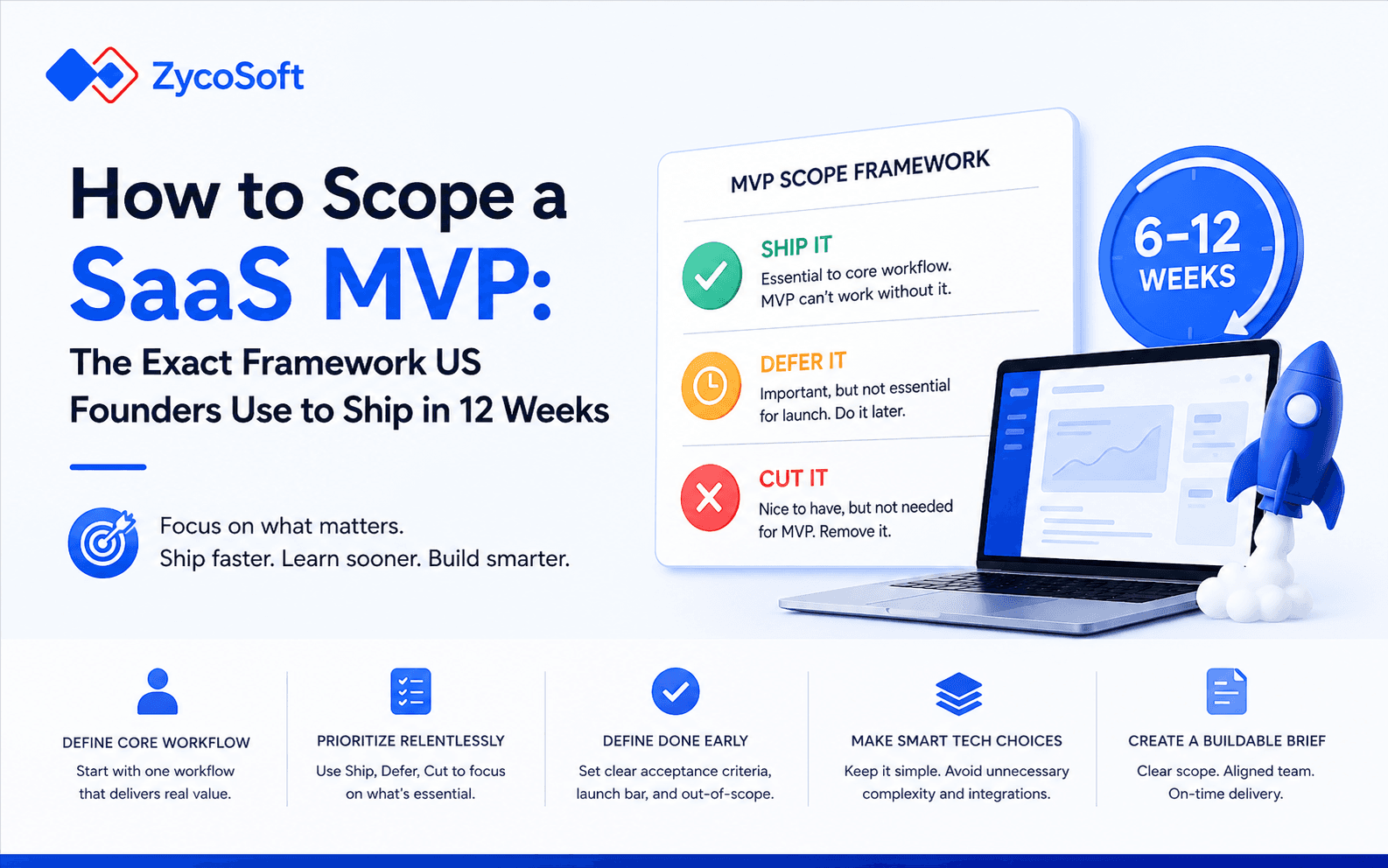
How to Scope a SaaS MVP: The Exact Framework US Founders Use to Ship in 12 Weeks
Most SaaS MVPs fail before a line of code is written. Not because the idea is wrong, but because the scope is. Founders arrive at a development partner with a feature list that would take nine months to build, call it an MVP, and then wonder why timelines slip and budgets collapse. Learning how to scope a SaaS MVP is not a preliminary task. It is the task.
This framework reflects the methodology we use at ZycoSoft with early-stage US founders preparing to ship their first or second SaaS product. It is structured around a 6 to 12 week delivery model, which only works when scope is locked, prioritised, and defended before development begins.
Why Most US Founders Over-Build Their First Version
The over-build problem is almost always a framing problem. Founders scope against the product they want to exist in 18 months, not the product that needs to exist in 12 weeks. The result is a feature list designed to compete with established players rather than to test whether the core problem is real and solvable.
There are three specific patterns that drive this consistently:
- Investor pressure to look complete before the product is ready
- Fear that a stripped-back version will seem unserious in demos
- Conflating the product vision with the launch requirement
A founder building a B2B workflow tool for US logistics teams once arrived with 47 features in scope for their MVP. After a structured scoping session, 31 of those were deferred and 9 were cut entirely. The remaining 7 formed a working product that shipped in 10 weeks and signed its first three paying customers within the first month. The 40 deferred features were not wasted thinking. They became the roadmap. But they were not the MVP.
As we explored in detail in How to Build a Custom SaaS Product: What US Founders Get Wrong Before Development Starts, the mistakes that derail a build almost always originate in the pre-development phase, not the development phase itself.
How to Define the Core Workflow Before Anything Else .
The correct starting point for MVP scoping is not a feature list. It is a single sentence: what is the one workflow this product must support at launch for a user to get value from it?
This sounds straightforward. It rarely is. Most founders can answer this question for their product vision. Far fewer can answer it for their MVP. The discipline is in the reduction.
The Core Workflow Test
Write down the primary user persona. Then write down, step by step, exactly what that persona needs to do from the moment they log in to the moment they achieve the outcome they came for. Every step in that sequence is a candidate for MVP scope. Everything outside that sequence is not.
If a US SaaS founder is building an employee onboarding tool, the core workflow might be: create a new hire record, assign an onboarding checklist, track completion, and notify the manager. That is four functional areas. SSO integration, reporting dashboards, API access, and white-labelling are not part of that workflow. They are post-launch features, regardless of how desirable they are.
The Three-Column Feature Prioritisation Framework
Once the core workflow is defined, every proposed feature goes through a three-column test. This is the most reliable tool for SaaS MVP feature prioritisation before a development brief is written.
- Ship it: Does this feature directly enable the core workflow? Without it, does the MVP fail to deliver the core outcome? If yes to both, it ships.
- Defer it: Does this feature improve conversion, retention, or usability at launch without being structurally essential? If yes, it goes into sprint two or the post-launch backlog.
- Cut it: Does this feature serve a secondary persona, a future use case, or an edge case that affects fewer than 20 percent of initial users? Cut it entirely from MVP consideration.
Applied rigorously, this test typically reduces a founding team's initial feature list by 40 to 60
- percent. That reduction is not a compromise. It is what makes a 12-week ship window achievable.
The features that land in the "defer" column are not lost. They form the product roadmap. The features in the "cut" column are either genuinely non-essential, or they reveal assumptions about the user that need validating first. Either way, they do not belong in a first build.
How to Define Done Before Development Starts :
One of the most common reasons SaaS MVP builds overrun is the absence of a clear definition of done. When "done" is not defined before the first sprint, it expands continuously as development progresses. Features get refined, edge cases get added, and the 12-week window becomes 20 weeks without a single deliberate decision being made.
A working definition of done for an MVP has three components:
- Functional acceptance criteria: For each feature in scope, what does it need to do for it to be considered complete? Write this in plain language, not technical specification.
- Launch threshold: What is the minimum quality bar for putting this product in front of real users? This is not perfection. It is the point at which real feedback becomes more valuable than further refinement.
- Out-of-scope confirmation: An explicit, written list of what is not in this version. This protects the timeline from well-intentioned additions during development.
Setting these three components before development begins is not bureaucracy. It is the mechanism that makes a fixed-timeline delivery model work. At ZycoSoft, this is the document that governs the relationship between the product team and the embedded engineering team throughout the build.
Technical Scope Decisions That Affect Your Timeline :
Scoping a SaaS MVP is not purely a product exercise. Two or three architectural decisions made at the scoping stage will either protect your 12-week window or destroy it.
Monolith First, Almost Always
For a first SaaS product with unvalidated scale requirements, a well-structured monolithic architecture almost always delivers faster than a distributed one. The complexity cost of microservices at MVP stage is a timeline risk that most early-stage products cannot justify. If you are weighing this decision, the Monolithic vs Microservices Architecture for SaaS: A Practitioner Decision Framework lays out the trade-offs in detail.
Integrations and Authentication
Two specific areas consistently expand scope beyond what founders anticipate: third-party integrations and authentication systems. Both should be scoped conservatively at MVP stage.
- Limit integrations to one or two that are genuinely required by the core workflow, not every tool your target users happen to use
- Use a proven authentication library or service rather than building custom auth, this alone can save two to three weeks
- Defer SSO, SAML, and enterprise identity provider support to a post-launch sprint unless your first customer explicitly requires it
Payment Integration
If your MVP requires billing, use a single payment provider. ZycoSoft has production experience with Stripe, Mollie, and Razorpay integrations, and the consistent advice is the same: pick one, implement it cleanly, and add alternatives only when a specific market or customer segment demands it. Multi-provider billing at MVP stage is a scope expansion that almost never justifies the timeline cost.
Translating the Scope into a Brief Your Development Team Can Build From
A completed MVP scoping process should produce a brief that any competent development team can read and begin planning against without a discovery call. If your brief requires extensive verbal explanation to be understood, it is not finished.
A buildable MVP development brief contains:
- The primary user persona and the core workflow in plain language
- A prioritised feature list with Ship, Defer, and Cut columns completed
- Functional acceptance criteria for every in-scope feature
- Explicit out-of-scope confirmation
- Stack preferences or constraints, if any
- The target launch date and what success looks like at week 12
This document is what makes how to scope a software project a question with a concrete, actionable answer rather than a vague planning exercise. It also protects you in the development relationship. When scope is documented and agreed before the first sprint, additions cannot be absorbed silently into the timeline. They become explicit decisions with explicit trade-offs.
If you are preparing to scope your SaaS MVP and want a structured scoping engagement before committing to a full build, speak to the ZycoSoft team. We work with US founders at exactly this stage, helping translate a validated idea into a scoped, buildable brief that supports a 6 to 12 week delivery window.
Frequently Asked Questions
A thorough MVP scoping process typically takes one to two weeks when done before development starts. This includes defining the core user workflow, running feature prioritisation exercises, setting acceptance criteria, and agreeing on a technical approach. Rushing this stage is one of the most common reasons MVP builds run over time and over budget.
A solid MVP scope document covers the primary user persona, the single core workflow the product must support, a prioritised feature list with clear in-scope and out-of-scope boundaries, a definition of done for launch, and the technical stack decisions. It should also capture what success looks like at week 12, not at year one.
Apply a simple three-column test to every proposed feature: does it directly support the core workflow, does it improve conversion or retention at launch, or does it serve a secondary use case? Features that only answer yes to the third question belong in a post-launch backlog. Most MVP scopes can be reduced by 40 to 60 percent using this filter alone.
The most common cause is conflating the product vision with the launch requirement. Founders plan for the version that competes with established players, not the version that tests whether the core problem is real and solvable. Investor pressure and fear of looking underpowered in demos compound this. A disciplined scoping process separates the two from the start.
Yes, provided the scope is fixed before development begins, the team is structured correctly, and the feature list has been reduced to the single core workflow. ZycoSoft delivers SaaS MVPs within a 6 to 12 week window using embedded teams and a scoping methodology that locks priorities before the first sprint. The 12-week ceiling only holds when scope is controlled from day one.
MVP scoping defines the minimum feature set required to get a working, testable product in front of real users. Product roadmapping plans the evolution of that product over subsequent quarters. The two are related but distinct exercises. Conflating them during the pre-build phase is a primary driver of scope creep and missed launch windows.