
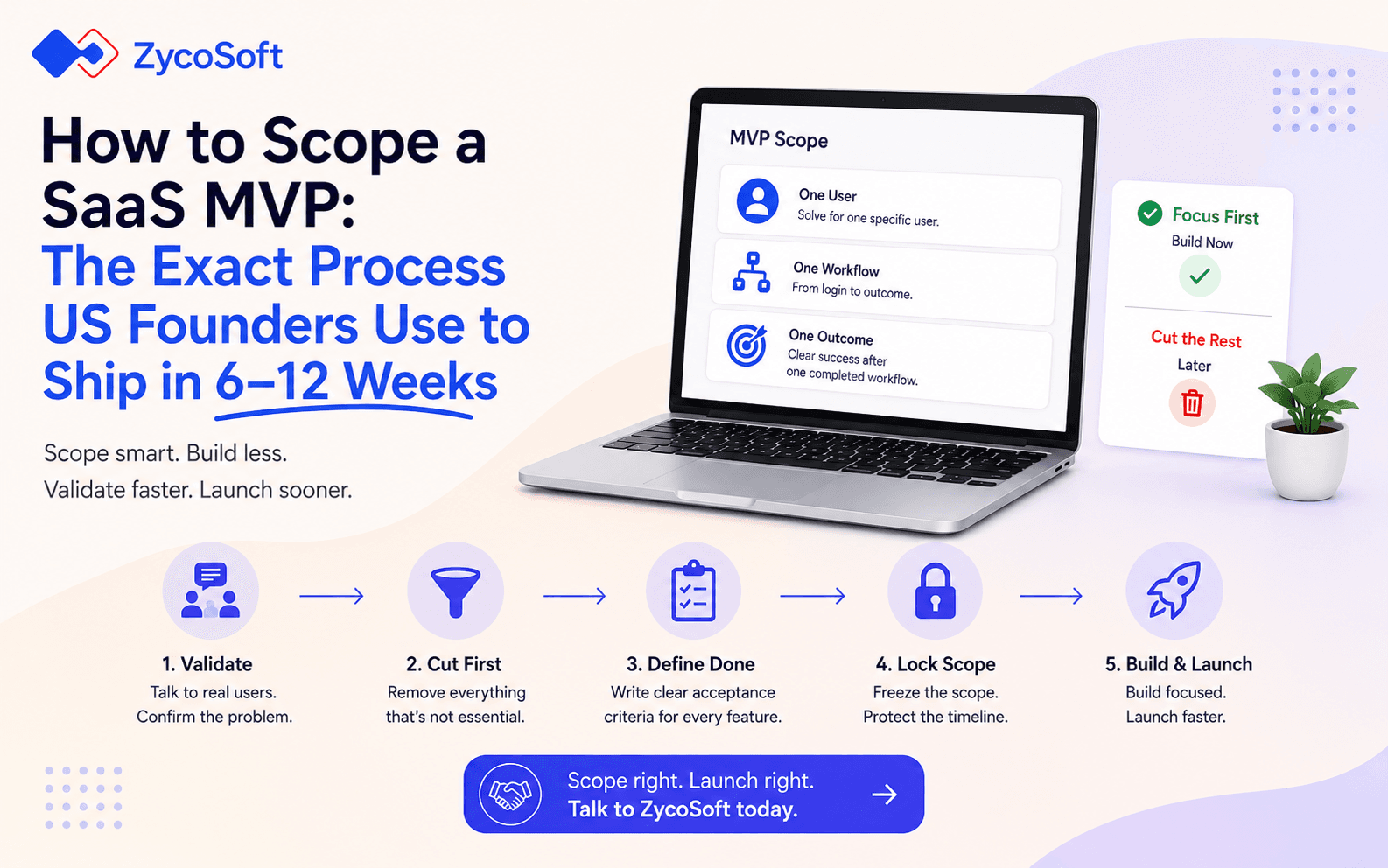
How to Scope a SaaS MVP: The Exact Process US Founders Use to Ship in 6–12 Weeks
Most SaaS MVPs do not fail in development. They fail before development starts, because nobody properly defined what the product is, what it does for one specific user, and what success looks like after eight weeks of building. The result is a scope that expands every sprint, a launch that slips by months, and a product that does too much for nobody in particular.
Learning how to scope a SaaS MVP correctly is the highest-leverage thing a founder can do before engaging any build team. This post gives you the exact process, including what to cut, how to define done, and where US founders consistently over-engineer their first build.
Start With One Workflow, Not a Feature List
The most reliable way to scope a SaaS MVP is to identify the single core workflow your product must complete, end to end, for one type of user. Not a list of features. Not a product vision. One workflow.
A workflow has a clear start and a clear end. For a B2B invoicing tool, the workflow might be: a user logs in, creates an invoice, sends it to a client, and marks it paid. Every feature that does not directly support that sequence is out of scope for the MVP. This sounds obvious, but most founders arrive at a scoping conversation with a 40-item feature list built from competitor analysis, investor feedback, and personal preferences, rather than from a validated user workflow.
Before you write a single user story, answer these three questions in writing:
- Who is the specific user completing this workflow? (Job title, company size, context.)
- What does that user need to be able to do, from login to outcome, in the MVP?
- What does success look like for that user after completing the workflow once?
If you cannot answer all three without hedging, your scope is not ready. Every qualified development partner should ask you these questions before agreeing to build. At ZycoSoft, this is the first gate in our pre-build process, and we will not proceed past it until the answers are specific and stable.
How to Prioritise Features: The Cut-First Method
The SaaS MVP scope problem is almost always one of addition, not omission. Founders add features to feel safe. The correct method is to start with everything cut and add back only what is strictly necessary to complete the core workflow.
Apply the Must-Enable Test
For every proposed feature, ask: can a paying user complete the core workflow without this? If yes, it does not belong in the MVP. This single test will remove 40 to 60 percent of the average founder's initial feature list before any prioritisation framework is applied.
Categorise What Remains
Once you have applied the must-enable test, sort the surviving features into three buckets:
- Build now: Required to complete the core workflow end to end.
- Build next: Needed within 60 days of launch, based on confirmed user feedback.
- Build later: Commercially interesting but not required for early validation.
Common items that almost always belong in "build later" for a first SaaS MVP include advanced analytics dashboards, white-labelling, multi-currency or multi-language support, mobile native applications, webhook frameworks, and complex role-based access beyond basic admin and user. These feel essential until you force yourself to articulate exactly which paying user, in which workflow step, needs them on day one.
As this breakdown of what US founders get wrong before development starts explains, the most damaging mistake is conflating what investors want to hear with what early users actually need. Those are rarely the same list.
Architecture Decisions That Kill MVP Timelines :
Over-engineering the technical foundation is the single fastest way to turn a 10-week MVP into a 9-month project. Most early-stage SaaS products do not need a microservices architecture, event-driven infrastructure, or a custom-built API gateway at launch.
A well-built monolithic application can support thousands of concurrent users, iterate rapidly, and scale to significant revenue before architectural complexity becomes a genuine constraint. The decision to introduce microservices should be driven by real scale problems, not by what seems impressive in a technical specification document.
If you are uncertain which architecture is appropriate for your product at this stage, this practitioner decision framework on monolithic versus microservices architecture for SaaS gives you a structured way to make that call before you commit to a technical direction.
The same principle applies to payment infrastructure, user management, and third-party integrations. Use established services (Stripe for payments, Auth0 or similar for authentication) rather than building from scratch. Custom-built versions of solved problems will consume weeks of build time and introduce reliability risks that a paying customer will encounter on their first session.
How to Define Done for a SaaS MVP
A SaaS MVP scope document is only useful if it includes a clear definition of done for each feature. Without this, "done" becomes whatever the developer thought you meant, which is almost never what you actually meant.
Write Acceptance Criteria, Not Descriptions
For each feature in your scope, write at least two acceptance criteria in the following format: Given [context], when [action], then [outcome]. This forces specificity and eliminates the ambiguity that causes rework.
For example, rather than writing "users can reset their password," write: "Given a user enters a registered email address on the password reset screen, when they submit the form, then they receive a reset link within 60 seconds and the link expires after 24 hours." That is testable. The former is not.
Define the Scope Lock Date
Every MVP engagement needs a scope lock date: a point after which no new features can be added to the current build cycle without formally removing something of equivalent size. This is not a bureaucratic constraint. It is the mechanism that makes a 6 to 12 week timeline achievable.
At ZycoSoft, the scope lock document is signed off by both the founder and the build team lead before development begins. Change requests after lock are handled through a formal process with a time and cost impact statement. This protects the timeline and keeps both sides accountable.
Locking Scope Before You Hire a Development Partner
The order of operations matters significantly. Many US founders engage a development agency, describe a vague product concept, and expect the agency to define scope on their behalf. Some will. Most will build what they are told, bill for the changes, and hand back a product that does not match the founder's mental model.
The correct sequence for how to scope a SaaS MVP before engaging a build team is:
- Validate the core workflow with at least five real potential users through interviews.
- Write the primary workflow as a step-by-step narrative, not a feature list.
- Apply the cut-first method and categorise all features into the three buckets above.
- Write acceptance criteria for every feature in the "build now" bucket.
- Produce a one-page scope summary that includes: core workflow, in-scope features, explicitly out-of-scope items, third-party dependencies, and definition of done.
- Bring this document to development partner conversations and use their response as a qualification filter.
A competent development partner will challenge your scope, not just accept it. They will identify technical risks in your dependencies, flag features that are more complex than they appear, and push back on anything that threatens the timeline. If a partner accepts your scope document without a single question, treat that as a warning sign, not a green flag.
Understanding how to scope a software project before talking to any developer gives you the foundation to walk into those conversations with clarity and authority, rather than deferring technical decisions to people who do not know your business.
The MVP development process is not a creative exercise. It is a discipline. The founders who ship in 6 to 12 weeks are not the ones with the best ideas. They are the ones who defined a specific problem, cut everything that did not solve it, and locked scope before writing a single line of code.
If you are preparing to scope a SaaS MVP and want a team that imposes this discipline before agreeing to build, speak to ZycoSoft directly. We will tell you what to cut, what to build first, and what a realistic timeline looks like for your specific product.
Frequently Asked Questions
A structured scoping process for a SaaS MVP typically takes two to four weeks before development begins. This includes problem validation, user story mapping, feature prioritisation, and producing a scope document. Rushing this stage is the most common reason MVPs run over time and over budget. Founders who invest in scoping upfront consistently ship faster than those who start building with loose requirements.
A SaaS MVP scope of work should include the primary user workflow, a prioritised feature list with clear inclusion and exclusion decisions, authentication and access control requirements, third-party integration dependencies, a definition of done for each feature, and agreed acceptance criteria. It should also specify what is explicitly out of scope, so both the founder and the development team are aligned before a single line of code is written.
Cut any feature that does not directly enable the core user workflow to be completed end to end. A useful test is to ask: can a paying user get value from this product without this feature? If the answer is yes, cut it. Common items to defer include advanced reporting, multi-tenancy, white-labelling, admin dashboards beyond basic user management, and integrations that fewer than 80 percent of early users will need on day one.
Most SaaS MVPs overrun because scope was never properly locked before development started. Founders add features mid-build, requirements change without a formal change process, and the definition of done is ambiguous. A secondary cause is over-engineering: choosing microservices architecture, building multi-tenant infrastructure, or adding API layers for integrations that do not yet have confirmed demand. Disciplined scoping and a clear scope lock document resolve both problems.
A founder should engage a development partner once the scope document is complete, the primary workflow is validated with real users or interviews, and the definition of done is agreed. Bringing in a build team before this point leads to scope drift and wasted budget. The right partner will also pressure-test the scope before agreeing to build, flagging technical risks, over-engineered decisions, and missing requirements that would cause problems later.