
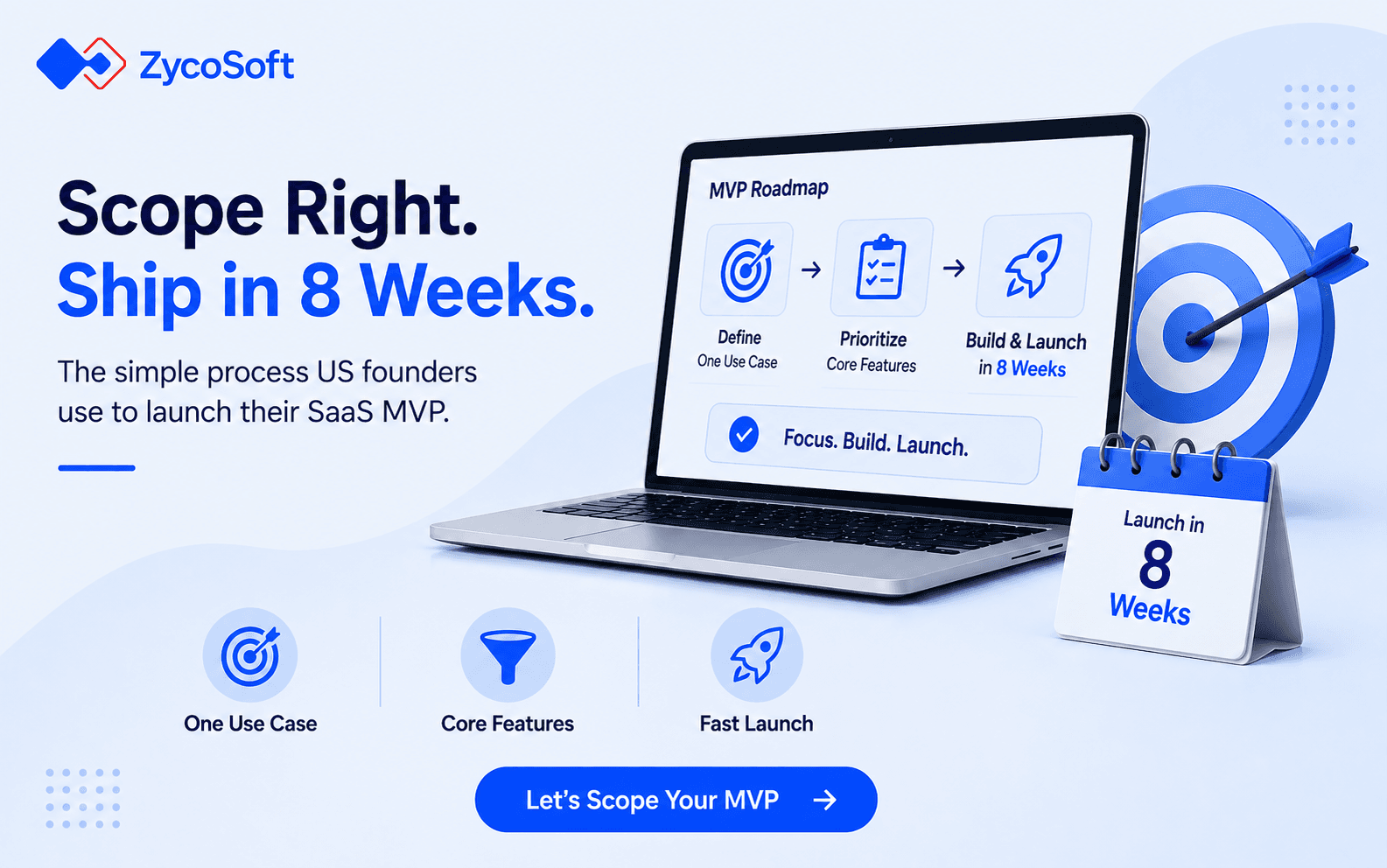
How to Scope a Custom SaaS MVP: The Exact Process US Founders Use to Ship in 8 Weeks.
A founder based in Austin had spent three months working with a development agency before a single feature went live. He had a clear problem to solve, a target customer segment he understood well, and a product vision he could articulate in two sentences. What he did not have was a scope. Every week, a new conversation with an advisor or a prospective customer added a requirement. The agency, happy to accommodate, kept revising estimates. By month three, the project had doubled in size and the original eight-week promise had quietly been abandoned.
He was not unusual. This pattern repeats across early-stage SaaS builds more often than any post-mortem report captures. The founder was not being reckless. He was responding rationally to new information, which is exactly what founders are supposed to do. The problem was structural: he had moved into development without a scoping process that could absorb new information and still protect the timeline.
The fix was not to stop listening to customers. It was to run a proper scoping engagement before development started, agree on what done meant, and put everything else in a version two backlog. That single structural change is what separates founders who ship in eight weeks from those who are still building at month eight.
Why Scoping Determines Your Timeline Before Development Begins
Scope is set before a line of code is written or it is never truly set at all. This is the foundational truth of custom SaaS product development, and it is the one most founders discover too late.
When scope is undefined at the start of a build, every ambiguous requirement becomes a decision point inside the sprint. Developers ask clarifying questions. Answers introduce new edge cases. Edge cases become features. Features extend timelines. The build does not collapse because of bad engineering; it collapses because the product was never fully defined before the engineering started.
Structured software project scoping solves this by forcing decisions upstream. A development partner that treats scoping as a paid, dedicated engagement rather than a free discovery call is doing the founder a service. Two to three weeks of structured scoping work, producing a fixed scope document with explicit in-scope and out-of-scope decisions, is worth more to an eight-week timeline than any amount of engineering velocity. As outlined in this breakdown of software project scoping fundamentals, the decisions you make before talking to developers define what your developers are actually capable of building on time.
The Single Primary Use Case Rule:
Every MVP that ships on time is built around one job-to-be-done. Not a platform, not an ecosystem, not a suite of tools. One specific action that one specific user type needs to complete, and completes better with your product than without it.
Defining this use case is harder than it sounds. Most founders arrive at a scoping conversation with a product that solves three related problems and serves two user types. The scoping process does not dismiss that ambition; it sequences it. It identifies which single use case, if delivered cleanly, would compel a first paying customer to sign up. Everything else is version two.
A useful test is this: write the primary use case as a single sentence in the format, "A [user type] uses this product to [complete specific action] so that [measurable outcome]." If you cannot write that sentence without using the word "and," your scope is still too broad.
What to Cut and What to Keep :
Ruthless feature cutting is not about building less. It is about protecting the features that actually matter by not letting secondary features consume the build time and budget that primary features need.
Apply this filter to every proposed feature before it enters the scope document:
Does this feature directly enable the primary use case for the first paying user?
Does removing it prevent the product from being usable at launch?
- Does it represent a regulatory, security, or data integrity requirement that cannot be deferred?
If the answer to all three is no, the feature goes into a version two backlog. It is not discarded; it is sequenced. This distinction matters for founders who worry about cutting things their customers will expect. Documenting the backlog explicitly reassures the team that the decision is strategic, not permanent.
Common features that routinely survive this filter when they should not include:
- Admin dashboards for managing users (needed eventually, not at launch)
- Advanced analytics and custom reporting views
- Multi-currency or multi-language support
- Complex notification preference centres
- Public-facing API or developer documentation
The architecture decisions made during scoping also affect what can be deferred safely. Choosing between monolithic and microservices architecture at this stage directly determines how cleanly you can add those version two features without rebuilding the core.
How to Define Done Before Sprint One Starts
Scope without acceptance criteria is not scope. It is a wish list. Defining done is the step that converts a feature list into something a development team can build against without daily clarification calls.
For each feature in the scope document, the scoping engagement should produce:
- A functional description: what the feature does, from the user's perspective, in plain language.
- Acceptance criteria: the specific conditions under which the feature is considered complete. These should be testable, not subjective.
- Edge cases acknowledged: the known edge cases and whether they are in scope for the MVP or deferred.
- Integration dependencies: any third-party services, payment providers (such as Stripe or Mollie), or APIs that the feature relies on, confirmed as available before development starts.
This level of definition feels laborious before you have done it. After your first mid-build rework, it feels essential. The Austin founder referenced at the opening of this post spent six weeks in rework because "notifications" had entered the scope as a single line item. It covered, depending on who you asked, either a simple in-app alert or a full email and SMS workflow with user preferences. Acceptance criteria would have resolved that in the scoping phase for a fraction of the cost.
Scoping as a Paid Engagement: Why It Changes the Dynamic
Founders frequently expect scoping to be free, bundled into a proposal as a commercial courtesy before the real engagement begins. This expectation, while understandable, undermines the quality of the scoping work itself.
When scoping is unpaid, it is rushed. The development partner is incentivised to produce an estimate quickly and move to contract, not to surface every ambiguity and force difficult prioritisation decisions. The result is a scope document that looks complete but contains enough vagueness to expand substantially during the build.
A paid scoping engagement changes the incentive structure on both sides. The development partner commits dedicated time to producing a complete, fixed scope document. The founder commits real attention to the decisions that document requires. Both parties enter the build phase with shared, written agreement on what is being built, what it will cost, and when it will be done.
At ZycoSoft, scoping is a separate, structured engagement that runs before any development sprint begins. It produces a scope document, a technical architecture recommendation, a sprint plan, and acceptance criteria for every feature. The embedded team then enters sprint one with no ambiguity about what done means. This is precisely what custom SaaS product development for serious timelines requires, and it is the approach that most US founders wish they had insisted on before their first build started.
The 8-Week MVP: What It Actually Requires
Eight weeks is achievable for a custom SaaS MVP. It is not a marketing claim. It is the natural output of a properly scoped build with a single primary use case, a fixed feature set, defined acceptance criteria, and a team that is not making architectural decisions mid-sprint.
What it requires from the founder:
- One decision-maker with authority to approve scope decisions during the scoping phase, not a committee.
- Willingness to put version two features in writing and commit to not reintroducing them during the build.
- Availability for a weekly sprint review, typically one hour, to give feedback before the next sprint begins.
- Third-party credentials and API access confirmed before development starts.
What it requires from the development partner: a scoping process that is structured enough to produce fixed deliverables, an embedded team with genuine SaaS product experience, and a communication model that does not add latency to the feedback loop.
The Austin founder eventually got his product live. It took five months longer than it needed to, and the rebuild cost him roughly 40% of his initial development budget. His second product, built with a structured scoping engagement in place, shipped in nine weeks. The product was smaller than he originally imagined. It was also the one that got him his first ten paying customers.
If you are preparing to commission a custom SaaS build and want to start with a scoping engagement that produces a fixed scope document, sprint plan, and acceptance criteria before any development begins, speak to ZycoSoft directly. Bring your use case. We will help you define what ships in eight weeks and what waits for version two.
Frequently Asked Questions
A structured scoping engagement typically takes two to three weeks. This covers primary use case definition, feature prioritisation, technical architecture decisions, and producing a scope document with acceptance criteria. Founders who skip this phase and move straight to development routinely add two to four months to their overall timeline through mid-build scope changes and rework.
A solid MVP scope document includes the single primary use case the product solves, a prioritised feature list with explicit in-scope and out-of-scope decisions, user roles and access levels, third-party integrations required at launch, a definition of done for each feature, and a version two backlog. It should be specific enough that a developer can enter sprint one without clarification calls.
Apply a single test to every proposed feature: does it directly enable the first paying user to complete the primary use case? If the answer is no, the feature belongs in a version two backlog. Common cuts include admin dashboards, advanced reporting, multi-currency support, and notification preferences. These feel essential during planning but rarely affect early adoption or first-round validation.
ZycoSoft runs scoping as a paid, structured pre-development engagement before any build work begins. This produces a scope document, technical architecture recommendation, sprint plan, and acceptance criteria. Development then begins with full scope clarity. The embedded team follows Western work practices, communicates in UK and US business hours overlap, and delivers against a fixed 8-week MVP timeline where scope supports it.
Early-stage founders are still discovering what their product actually is. Without a structured scoping process, every stakeholder conversation adds a feature and every investor question shifts a priority. Later-stage companies have product managers and documented processes to contain this. Founders at the MVP stage need a structured external scoping engagement to impose the same discipline before development starts, not during it.
Reliability in offshore SaaS product development depends almost entirely on the scoping and communication structure, not geography. A remote engineering partner that runs a paid scoping phase, delivers a fixed scope document, and operates with Western work practices and transparent sprint reporting is more reliable than a local agency that starts building before scope is agreed. The scoping phase is where reliability is established, not during the build.