
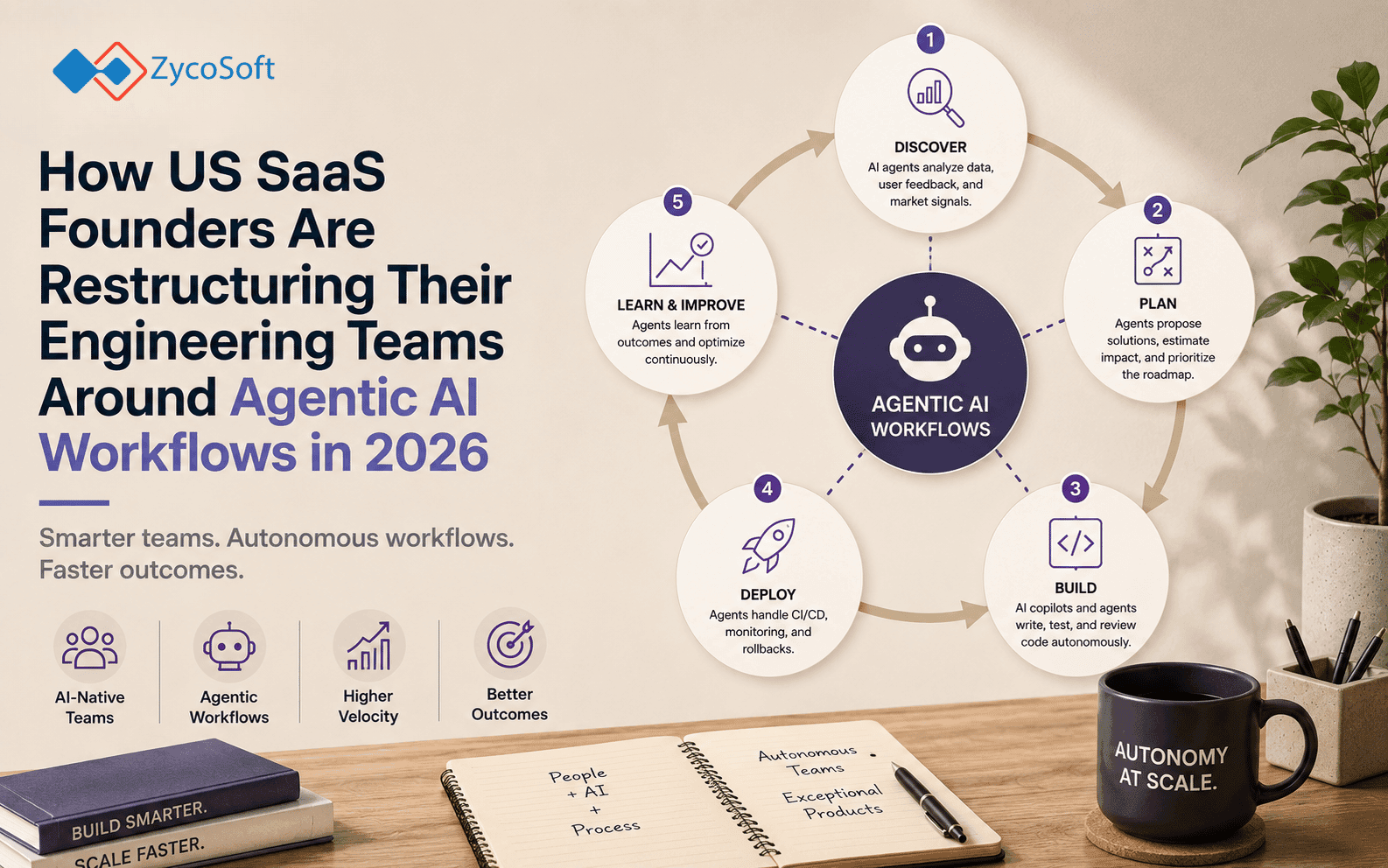
How US SaaS Founders Are Restructuring Their Engineering Teams Around Agentic AI Workflows in 2026 .
Most US SaaS founders who planned to scale their engineering teams by headcount this year are now staring at a different set of trade-offs. Agentic AI has moved from experiment to genuine workflow layer inside product engineering teams, and it has done so quickly enough to make headcount plans drafted 18 months ago look structurally wrong. The question is no longer whether AI changes how teams work. It is whether your current team structure is built to capture that change or whether it is absorbing cost while AI sits unused at the edges.
What Agentic AI Actually Changes About Engineering Capacity ?
Agentic AI systems do not simply autocomplete code. They reason over context, execute multi-step tasks, make intermediate decisions, and hand off to the next stage of a pipeline without a human at each junction. That is a fundamentally different capability from a code suggestion tool, and it has a direct impact on how engineering capacity should be planned.
The tasks that agentic AI absorbs most reliably in a SaaS engineering context include:
- Test case generation and regression suite maintenance.
- Documentation and code commentary at scale.
- Boilerplate scaffolding for new modules or services.
- Routine bug triage across known error patterns.
- Data transformation and pipeline monitoring tasks.
These are not trivial tasks. Across a mid-sized SaaS product team, they typically consume between 30 and 40 percent of mid-level engineering time. When agentic AI absorbs them, that capacity is freed, which means founders have a real choice: redeploy that time toward higher-value work, or stop hiring the roles that were filling it.
For a deeper look at how agentic AI differs architecturally from standard automation, this breakdown of AI agents versus traditional workflow automation is worth reviewing before restructuring any pipeline decisions.
Where Agentic AI Creates Engineering Complexity, Not Headcount Savings ?
The founders who are struggling with agentic AI adoption are not struggling because the tools do not work. They are struggling because they underestimated what it takes to govern AI pipelines at production quality. Agentic systems introduce new engineering responsibilities that most existing teams are not resourced to handle.
New Engineering Roles Agentic AI Demands -
When you introduce agentic AI into your product engineering workflow, you create demand for engineers who can:
- Design and maintain the orchestration layer across multiple agents
- Write reliable prompt logic and manage context windows at scale
- Build evaluation frameworks to catch hallucinations and output drift
- Instrument observability into AI pipelines so failures surface cleanly
- Manage security boundaries when agents have access to production data or APIs
None of these are skills you find by default in a standard engineering hire. They require engineers who have shipped agentic systems into production, not just prototyped them. Founders who discover this gap mid-sprint are the ones who end up delayed by the very tooling they adopted to move faster.
Where Human Engineering Judgement Remains Non-Negotiable ?
Architecture decisions, cross-system integration, security model design, and complex debugging all remain firmly in the domain of senior engineering judgement. Agentic AI can surface options and generate candidate solutions, but the evaluation of those options in the context of your specific product, your data model, and your compliance requirements requires an experienced engineer with accountability. Removing that layer is where production incidents originate.
The Headcount Decision: Hire Locally, Embed a Remote Team, or Automate the Gap
This is the practical question founders are sitting with. The answer depends on three variables: what your roadmap demands over the next 6 months, what engineering skills you already have in-house, and how mature your agentic AI governance layer is.
When Local Hiring Is the Right Call
Local hiring makes sense when you are building a capability that requires deep, continuous institutional knowledge and where the role cannot be effectively split from your core team's daily rhythm. A founding engineering hire or a head of infrastructure who will own your cloud architecture long-term fits this profile. The problem is that local senior engineering hires in US markets currently take 4 to 9 months to close, cost significantly more in total compensation than equivalent roles through a dedicated remote development team, and leave founders exposed during the gap.
When a Dedicated Remote Development Team Outperforms Local Hiring ?
A dedicated remote development team is the right structure when your roadmap requires consistent senior-level delivery capacity that you cannot staff locally at speed, when you need engineers who already operate inside agentic AI workflows rather than learning on your product clock, or when your feature backlog spans skills (backend, frontend, AI pipeline engineering, DevOps) that would require multiple separate local hires.
Founders who have made this shift typically report a structure that looks like this:
- One or two in-house senior engineers holding architecture and product context.
- A dedicated remote development team of 3 to 5 senior engineers acting as a genuine team extension, not a task queue.
- Agentic AI pipelines handling the repeatable layer of engineering work across both groups.
This configuration ships faster than a 12-person mixed-seniority in-house team, with significantly less management overhead and without the productivity drag that comes from onboarding junior engineers into a complex codebase.
When Automation Alone Is Not Enough -
Some founders assume that agentic AI plus a minimal internal team can substitute for structured engineering capacity. This works only when your product is genuinely stable and your roadmap is incremental. If you are building new feature surface, integrating with third-party systems, managing a multi-tenant architecture, or operating in a regulated environment, the complexity exceeds what AI pipelines can handle without experienced engineers governing them. Trying to automate through a complexity gap produces technical debt faster than any other approach.
How to Audit Your Current Team Structure Against Agentic AI Realities :
Before making any hiring or restructuring decision, run this audit across your current engineering setup. It takes less than a day and surfaces the decisions you actually need to make.
- Map repeatable tasks: Identify every engineering task completed more than once per sprint that follows a predictable pattern. These are your agentic AI candidates.
- Assess seniority distribution: If more than 40 percent of your engineering team is mid-level or junior, agentic AI will not save you time. It will require more oversight than it reduces.
- Identify governance gaps: Check whether anyone on your team has shipped an agentic AI system to production. If not, that is your most urgent hiring or embedding need.
- Benchmark velocity against roadmap: Calculate how many sprints your current team needs to clear your 6-month backlog. If it exceeds 10, you have a capacity problem that AI tooling alone will not solve.
- Check your observability posture: If you cannot monitor what your AI agents are doing in production, you are not ready to give them more scope. Instrument first.
This audit frequently reveals that founders do not need more engineers in total. They need fewer, better engineers, paired with AI pipelines that are properly governed. That is the configuration a well-structured dedicated remote development team for SaaS founders delivers most efficiently.
What This Means Practically for Founders Deciding Now :
The window in which founders can ignore this restructuring is closing. SaaS competitors who have already paired senior embedded teams with production agentic AI pipelines are shipping features in timelines that bloated in-house teams cannot match. The compounding effect of that velocity gap is not theoretical. It is visible in product release cadences, customer acquisition, and funding conversations right now.
The structural answer for most growth-stage SaaS founders is not a larger team. It is a leaner, senior-weighted team, with a dedicated remote development team acting as a true engineering extension rather than a supplementary resource, and with agentic AI handling the repeatable layer under experienced governance. That is the configuration that makes the economics of SaaS engineering work at this stage of the AI cycle.
Founders who are still planning around headcount volume rather than engineering seniority and AI pipeline maturity are building a cost structure that will be difficult to unwind. The time to restructure is before the next hiring cycle, not after it.
If you are re-evaluating how your engineering team is structured and want to understand what a dedicated remote development team for SaaS founders looks like in practice, including how we integrate with agentic AI workflows at the production level, speak directly with ZycoSoft's engineering team. We will give you an honest assessment of what your current structure needs and what it does not.
Frequently Asked Questions
Not fully, and not safely. Agentic AI can absorb well-defined, repeatable engineering tasks such as test generation, documentation, boilerplate scaffolding, and some code review. It cannot reliably handle architecture decisions, cross-system integration, security boundaries, or complex debugging. The net effect is a reduction in the number of mid-level engineers needed, not an elimination of engineering expertise.
There is no universal number, but founders who have restructured around agentic AI workflows typically operate with 3 to 6 senior engineers rather than 10 to 15 mixed-seniority hires. The key shift is prioritising depth over breadth. Senior engineers directing AI agents are consistently more productive than larger teams where junior engineers require significant oversight.
A dedicated remote development team makes sense when you need consistent senior-level capacity without the 6 to 9 month local hiring timeline, when your product roadmap requires specialised skills you cannot recruit locally at speed, or when you need engineers who already understand how to work alongside agentic AI tooling rather than learning it on your product clock.
Agentic AI introduces demand for engineers who can design and maintain AI pipelines, write reliable prompt logic, build evaluation and observability layers, and manage the orchestration of multiple agents. These are net-new responsibilities. Most existing engineering teams do not have them, which is one reason founders are turning to embedded teams with production AI deployment experience.
When implemented correctly, agentic AI workflows can compress delivery timelines by 30 to 50 percent on well-scoped features. However, poorly governed AI pipelines introduce subtle bugs, inconsistent output quality, and security risks that slow teams down significantly. Velocity gains depend almost entirely on the quality of the engineers governing the agents, not on the AI tooling alone.
Standard workflow automation executes fixed, predetermined steps. Agentic AI systems reason over context, make intermediate decisions, and adapt their path based on outcomes. For engineering teams, this means agentic AI can handle tasks that previously required human judgment at each step, but it also means failures are less predictable and require experienced engineers to design appropriate guardrails.