
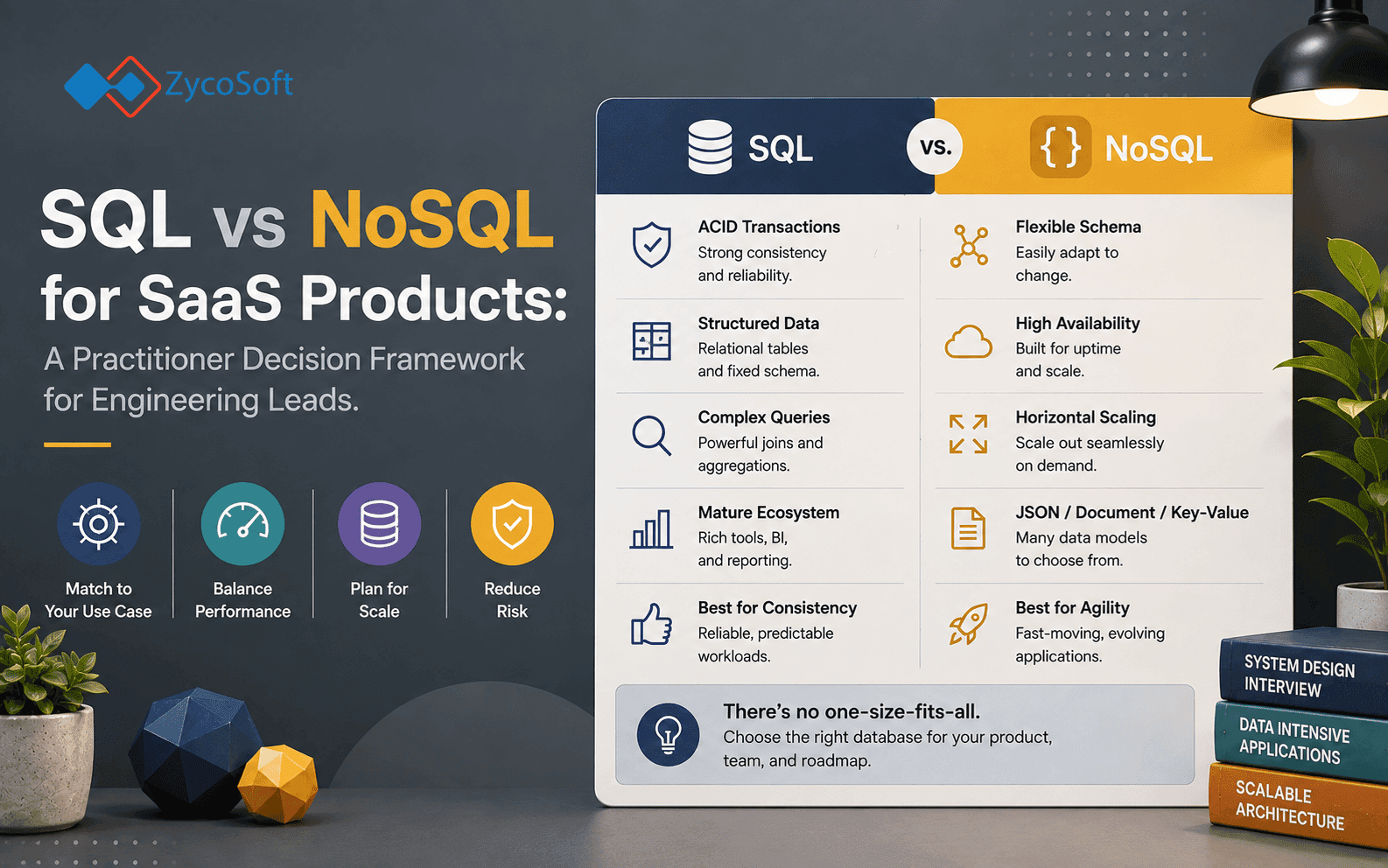
SQL vs NoSQL for SaaS Products: A Practitioner Decision Framework for Engineering Leads
The database decision most SaaS teams get wrong is not choosing the wrong engine. It is making the choice too early, based on assumptions about their data model that have not been tested against real query patterns. The cost shows up later: a shared-schema design that cannot support GDPR right-to-erasure at scale, or a MongoDB data model that requires cross-document aggregations nobody anticipated. This framework is designed to help engineering leads make the right call at each product stage, and to recognise when a hybrid approach is earned rather than premature.
Why the SQL vs NoSQL Question Is Really About Query Patterns and Isolation Requirements :
The correct starting point for any database decision is not "what is popular" or "what does our team know." It is: what are the primary access patterns, and what isolation does each tenant require?
Relational databases like PostgreSQL are optimised for set-based queries across normalised data. They excel when you need to join across entities, enforce referential integrity, and produce aggregate reports across tenant populations. NoSQL databases like MongoDB are optimised for retrieving complete documents by a known key, with variable structure per document. Neither is universally better. They are built for different access shapes.
The isolation question matters equally. A B2B SaaS product selling to enterprise clients in regulated industries has materially different isolation requirements than a high-volume SMB tool where tenants are lower risk. Multi-tenant architecture decisions drive your database design as much as the data model itself, and conflating them is a common source of expensive rework.
PostgreSQL as the Default: What It Handles Better Than You Might Expect
For the majority of SaaS products, PostgreSQL is the right default and should require a specific case to unseat it. The reasons are practical, not ideological.
PostgreSQL handles relational data with full ACID compliance, mature row-level security (RLS), and a rich indexing toolkit. For multi-tenant SaaS, you get two credible isolation models without changing engine:
- Schema-per-tenant: Each customer gets their own PostgreSQL schema. Migrations run per-schema. Backups and data deletion are clean. Strong logical isolation without separate databases.
- Shared schema with tenant_id: All tenants share tables, with a tenant_id column and row-level security policies enforcing access. Lower operational cost, suitable for high-volume SMB SaaS.
What surprises many teams is how far PostgreSQL JSONB takes you before you need a dedicated document store. A JSONB column on a relational table supports GIN indexing, partial updates, and operator-based querying. For use cases like user-defined custom fields on a CRM record, variable product attributes, or dynamic form responses, JSONB handles the flexibility without introducing a second database engine.
A short illustrative example: a tenant_attributes JSONB column on your tenants table, indexed with CREATE INDEX idx_tenant_attrs ON tenants USING GIN (attributes), lets you query SELECT * FROM tenants WHERE attributes @> '{"plan":"enterprise"}' with index support. That is document-store-level flexibility inside a relational model.
PostgreSQL also integrates cleanly with GDPR compliance tooling. Per-tenant schema deletion is a single DROP SCHEMA CASCADE. Row-level deletion under shared schema is a targeted DELETE WHERE tenant_id = X, and with proper RLS policies, you can audit exactly what data a given tenant can access. This matters enormously when you receive a right-to-erasure request from a UK or EU customer. Building GDPR-compliant architecture from day one is significantly easier when your data layer was designed with it in mind.
When MongoDB Is the Right Choice: Genuine Use Cases vs Hype
MongoDB is a good choice when your data model is genuinely document-centric, records vary significantly in structure across tenants or use cases, and you rarely need to join across documents. The key word is genuinely.
Real cases where MongoDB earns its place in a SaaS product include:
- CMS and content platforms where each content type has a different field set and nested structure.
- Configurable workflow builders where each workflow definition is effectively a self-contained document.
- Product catalogue tools where attribute schemas differ dramatically per category.
- Event ingestion pipelines where you are writing millions of records per day and schema enforcement at write time is a bottleneck.
The signal that MongoDB is the wrong choice is when your team starts building lookup tables to simulate joins, or when aggregation pipelines become the primary query mechanism for standard reporting. At that point, you have built a relational model inside a document store, and the impedance mismatch will accumulate as technical debt.
Multi-tenancy in MongoDB is typically implemented with a tenantId field on every document and application-layer enforcement. There is no native equivalent of PostgreSQL's row-level security, which means isolation guarantees depend on your application code being consistently correct. For regulated industries, that is a harder audit story than a database-enforced policy.
Scaling Thresholds: When the Early Decision Starts to Hurt
Most teams do not feel the consequences of a poor database choice until they hit a specific scale threshold. Knowing where those thresholds sit helps you make a more informed early decision.
For shared-schema PostgreSQL, the operational pressure typically arrives when a single tenant's table partition grows past roughly 50 to 100 million rows and vacuum, index bloat, or lock contention becomes visible. The architectural response is partitioning by tenant_id or migrating high-volume tenants to their own schema. Both are manageable with planning but expensive as emergency work.
For schema-per-tenant PostgreSQL, the pressure arrives at connection pooling. At several hundred tenants, a naively configured setup where each schema gets its own connection pool exhausts database connections quickly. PgBouncer with transaction-mode pooling and a shared connection pool across schemas solves this, but it needs to be designed in rather than retrofitted.
For MongoDB, the scaling challenge is often the aggregation pipeline. Read-heavy reporting queries that need to span documents across collections do not scale linearly, and the Atlas search tier adds cost quickly. Teams frequently end up running a read replica or a separate analytical store to offload those queries, which is the beginning of a hybrid architecture whether they planned it or not.
Hybrid Database Architecture: When It Is Justified and When It Is Premature
A hybrid architecture uses two or more database engines for distinct data types within the same product. The most common pattern in mature SaaS products looks like this:
- PostgreSQL for transactional data, tenant records, billing, and user accounts.
- Redis for session state, rate limiting, and hot-path caching.
- Elasticsearch or a vector store for full-text search or AI retrieval (RAG pipelines).
- A time-series database such as TimescaleDB or InfluxDB for metrics and usage data.
This architecture is justified when a single engine creates a measurable, demonstrated performance or capability bottleneck. It is not justified at MVP stage. Running three database engines at launch means three operational concerns, three backup strategies, three failure modes, and a data consistency problem between them that your team will spend real engineering time managing.
The right sequence is: start with PostgreSQL, use JSONB and RLS to defer the need for additional engines, and add a second engine only when you have production evidence that PostgreSQL cannot meet a specific requirement. The same logic that argues for a monolith before microservices applies directly to database architecture: operational simplicity at early stage is a feature, not a compromise.
How ZycoSoft Approaches the Data Layer Decision in Custom SaaS Projects :
The database choice is one of the first architecture decisions we work through in every custom SaaS development engagement, and it is one where the wrong early call is disproportionately expensive to unwind. We have seen teams inherit a MongoDB data model that needed five aggregation pipeline stages to produce a standard billing report, and schema-per-tenant setups running 800 schemas on a single RDS instance with no connection pooling strategy.
Our default position is PostgreSQL with schema-per-tenant for products targeting enterprise or regulated clients, and shared schema with RLS for high-volume SMB SaaS. We use JSONB for semi-structured fields before recommending a dedicated document store. We add Redis at the point where session or cache pressure is measurable, not speculative. We avoid introducing a vector store or full-text search engine until the product has users who need those capabilities in production.
This is part of a broader discipline in how we scope and architect SaaS products: we deliberately avoid over-engineering an MVP and under-architecting a product that needs to scale. Both failure modes have the same root cause, which is making structural decisions before the evidence is available to make them well. Our custom SaaS development practice covers the full lifecycle, from initial data model design through schema migration strategy, multi-tenant scaling, and GDPR-compliant data handling, so the decisions compound in the right direction rather than against you.
If you are making a database architecture decision for a new or scaling SaaS product and want a second opinion grounded in production experience, we are straightforward to talk to.
Talk to the ZycoSoft engineering team about your SaaS data architecture.
Frequently Asked Questions
For most SaaS products, PostgreSQL is the right default. It handles relational data, supports JSONB for semi-structured fields, has mature multi-tenancy patterns, and is well understood by most backend engineers. NoSQL makes sense when your primary access pattern is document retrieval, you have genuinely variable schema per record, or you are ingesting high-volume event or time-series data that relational tables handle poorly.
Schema-per-tenant gives each customer their own PostgreSQL schema, providing strong logical isolation and easier per-tenant backups and migrations. Shared schema puts all tenants in the same tables with a tenant_id column, which is cheaper to operate but harder to isolate and audit. Schema-per-tenant is preferable for regulated industries or enterprise clients. Shared schema works well for high-volume SMB SaaS where tenants are lower risk and operational simplicity matters more.
MongoDB is genuinely better when your data model is document-centric, records vary significantly in structure across tenants or use cases, and you rarely need to join across documents. CMS platforms, product catalogue tools, and configurable workflow builders are real cases. If you find yourself writing a lot of lookup tables to simulate joins in MongoDB, that is a signal the relational model would have served you better.
JSONB is PostgreSQL's binary JSON column type. It supports indexing, querying, and partial updates on arbitrary JSON structures within a standard relational row. It is a strong middle path when most of your data is relational but a subset of records have variable or user-defined fields, such as custom attributes on a CRM record or dynamic form responses. It avoids introducing a second database engine while still accommodating schema flexibility.
The most expensive failure mode is discovering at 50,000 rows per tenant that your shared-schema design cannot support per-tenant row-level security cleanly, or that your MongoDB collections need cross-document aggregations you cannot run efficiently. Both cases result in emergency re-architecture under load. The second cost is compliance: if you cannot quickly isolate and delete a single tenant's data, GDPR right-to-erasure requests become manual engineering work.
A hybrid architecture uses two or more database engines for different data types within the same product. For example, PostgreSQL for transactional and tenant data, Redis for session state and caching, and Elasticsearch or a dedicated vector store for search or AI retrieval. It is justified when a single engine creates a measurable performance or capability bottleneck. It is not justified at MVP stage, where the operational overhead of running multiple engines outweighs the benefit.