
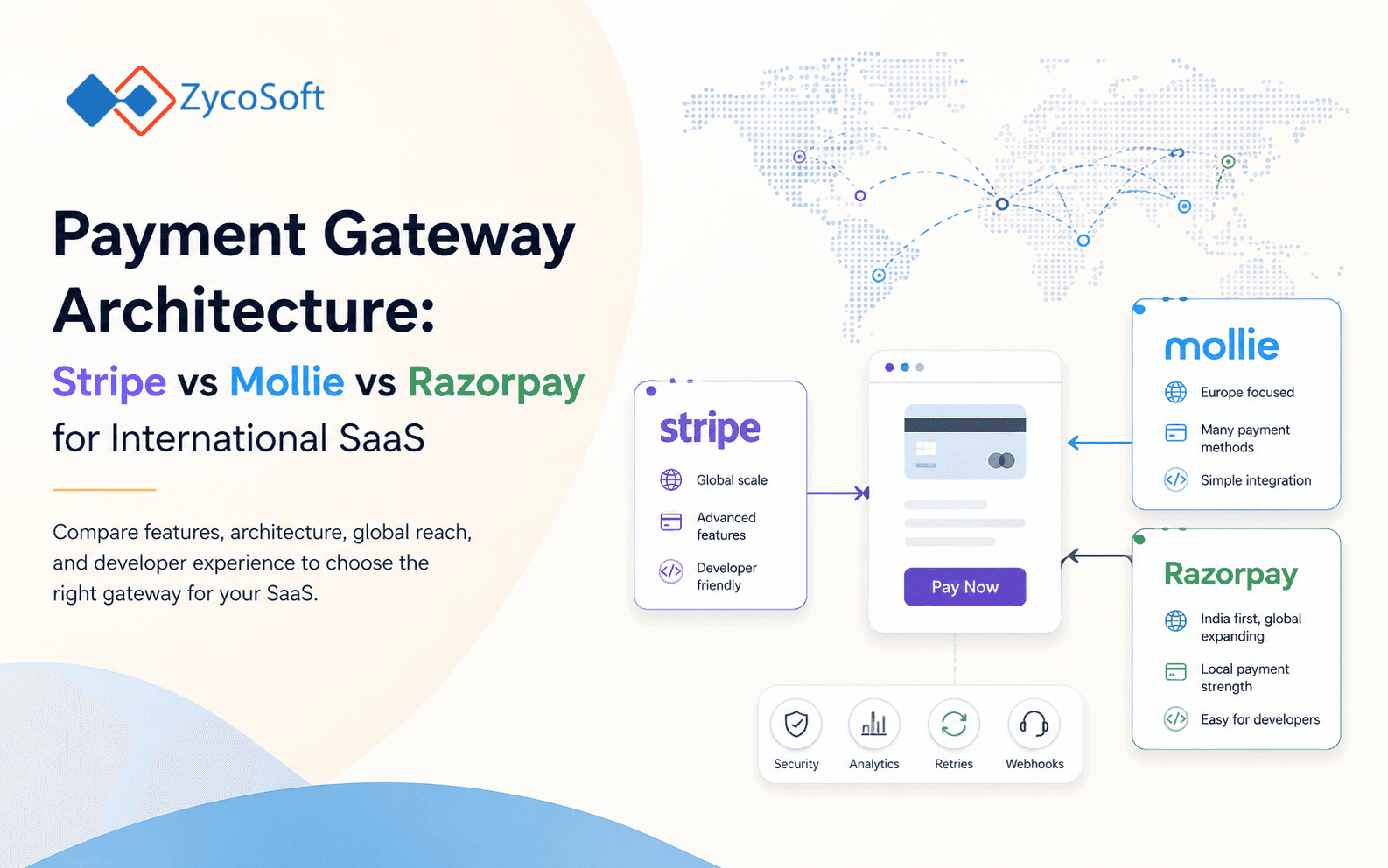
Payment Gateway Architecture: Stripe vs Mollie vs Razorpay for International SaaS
Why This Decision Matters More Than You Think
Most SaaS founders pick a payment gateway the way they pick a coffee order quickly, based on what everyone else is using, without reading the menu. That works fine at $5K MRR. It becomes expensive at $500K MRR when you realize your gateway charges 2.9% on every Indian UPI transaction that competitors process for 0.25%.
Payment architecture is infrastructure. It touches your conversion rates, revenue recognition, compliance posture, and customer experience in every market you operate in. Choosing the right gateway or the right combination is one of the highest-leverage technical decisions you'll make in year one.
At ZycoSoft, we've built payment infrastructure across all three platforms. This is the honest breakdown we wish existed when we started.
Stripe The Global Default
Stripe is the category default. Founded in 2010, it processes hundreds of billions annually and is the gateway of choice for most high-growth SaaS companies globally. There's a reason the developer experience is exceptional.
Stripe Billing is the most complete subscription management system of the three. Proration, trial periods, usage-based billing, tiered pricing, coupons, invoice generation it's all built in. For a SaaS company with complex pricing logic, this alone saves months of engineering time.
The API documentation is industry gold standard. Webhooks are reliable, the test environment is thorough, and the Stripe Dashboard gives you granular visibility into every payment event. Stripe Radar, their ML-powered fraud detection, is meaningfully better than anything Mollie or Razorpay offers.
Stripe Strengths: Best developer experience & docs, 135+ currencies across 40+ countries, industry-best subscription billing, ML fraud detection, Stripe Connect for marketplace payments, excellent dashboard, strong enterprise SLA.
Stripe Weaknesses: Higher fees vs regional alternatives, no UPI or Indian payment methods, iDEAL & Bancontact fees are higher in EU, not available in some emerging markets, account freezes can happen without warning, customer support can be slow at scale.
Standard fee: 2.9% + $0.30 per transaction. At $10K+ MRR, always negotiate they'll often come down to 2.2–2.5% for growing companies.
Mollie Europe's Hidden Weapon
Mollie is the payment gateway most non-European founders have never heard of and the one European founders quietly prefer. Based in Amsterdam, Mollie focuses almost entirely on the European market with no hidden fees and exceptional coverage of local payment methods.
The biggest differentiator is local payment method support. In the Netherlands, over 60% of online payments happen via iDEAL. In Belgium, Bancontact dominates. In Germany, SEPA Direct Debit is expected. Mollie supports all these natively at lower fees than Stripe charges for the same methods.
Mollie's pricing is genuinely transparent you pay per transaction with no monthly fee or setup fee. For a SaaS company with 80% European revenue, Mollie often works out 30–40% cheaper than Stripe on a blended basis.
Mollie Strengths: Best European local payment coverage, lower fees for EU transactions, no monthly or setup fees, iDEAL, SEPA, Bancontact, Klarna native support, clean pricing with no surprises, strong EU regulatory compliance, good developer API.
Mollie Weaknesses: No meaningful presence outside Europe, subscription billing less mature than Stripe, smaller ecosystem of integrations, no marketplace equivalent to Stripe Connect, weaker fraud detection, less polished dashboard.
Standard fee: €0.25 + 1.2% for iDEAL, 1.8% for cards, no monthly fee.
Razorpay The South Asia Specialist
Razorpay is the dominant payment infrastructure provider in India and is rapidly expanding across Southeast Asia. For any SaaS business with meaningful Indian revenue, it's not a choice it's a necessity. No other gateway comes close to Razorpay's coverage of Indian-specific payment rails.
India's payment ecosystem is unique. UPI (Unified Payments Interface) now processes over 10 billion transactions monthly and is the dominant payment method for consumers and B2B. Net banking, wallets (Paytm, PhonePe), and Indian credit/debit card flows all have nuances that a global gateway doesn't handle well. Razorpay was built from the ground up for this environment.
Beyond payments, Razorpay expanded into a full business banking stack current accounts, payroll (RazorpayX), smart collect, and route for marketplace payouts. For India-focused SaaS companies, this makes Razorpay more than a gateway it's your entire financial infrastructure layer.
Razorpay Strengths: Best UPI, NEFT, IMPS, wallet support, built for Indian compliance & RBI regulations, lowest fees for Indian transactions, full banking stack (RazorpayX), smart collect for B2B invoice payments, route for marketplace payouts, India-specific fraud protection.
Razorpay Weaknesses: Primarily India-only with limited global reach, international card support is secondary, documentation less polished than Stripe, subscription management less mature, not suitable as a solo gateway for global SaaS, support quality varies.
Standard fee: 2% per transaction, UPI as low as 0% (promotional), no setup fee.
Which Gateway Wins by Use Case
- Global B2B SaaS: Stripe wins. US, Europe, ROW customers. Complex subscription tiers. Best billing infrastructure.
- European SMB SaaS: Mollie wins. Dutch, Belgian, German customers. Local payment methods critical for conversion.
- India-Market SaaS: Razorpay wins. Indian SMB or consumer customers. UPI & wallet support non-negotiable. INR billing required.
- Marketplace/Platform: Stripe Connect wins. Multi-vendor payouts, split payments, connected accounts.
- EU Subscription-First: Mollie wins. High-volume recurring revenue in Euros. Cost optimization priority. EU-only market.
- Multi-Market Scale-Up: Multi-Gateway wins. US + Europe + India revenue. Can't afford to leave conversion on the table.
The Decision Framework
If you're selling globally to English-speaking markets (US, UK, CA, AU) with card-first customers → Stripe.
If you're selling into European markets where iDEAL, Bancontact, or SEPA are expected → Mollie.
If you're selling into India or South Asia where UPI and local wallets are dominant → Razorpay.
If you're selling across all three regions at meaningful volume route by geography for lowest cost and highest conversion → Multi-Gateway.
If you're unsure start with Stripe. It has the highest ceiling and lowest switching cost. Layer in Mollie or Razorpay when regional revenue justifies it.
Building a Multi-Gateway Architecture
Once your SaaS hits meaningful international revenue roughly $50K+ MRR with clear geographic distribution a multi-gateway architecture pays for itself. Route each payment to the gateway best suited to serve that customer's region, payment method, and currency.
Build your billing layer against a single internal interface PaymentGateway.createSubscription(), PaymentGateway.chargeCustomer() and implement gateway-specific adapters behind it. This lets you add, remove, or swap gateways without touching core billing logic.
The ZycoSoft payment module ships with this abstraction built in, so you never have to choose just one gateway.
The ZycoSoft Take
There is no universally correct answer here. Stripe is the best default for a global SaaS that wants to minimize complexity and maximize capability. Mollie is smarter for European-first businesses where local payment methods drive conversion. Razorpay is non-negotiable the moment India becomes meaningful revenue.
The mistake most founders make is treating this as a permanent, either/or decision. It isn't. Your payment architecture should evolve with your geographic revenue distribution. What serves you at $10K MRR won't serve you at $1M MRR across three continents.
Build the abstraction layer early. Add gateways as markets justify them. Never choose your payment gateway based on which one your co-founder used at their last company.
Your payment architecture should be flexible, not fixed.
Frequently Asked Questions
Absolutely. We recommend it once you hit $50K+ MRR with geographic diversity. Use Stripe for US and Global markets, Mollie for Europe, and Razorpay for India. Route by customer location for lowest fees and highest conversion. Most SaaS companies run 2 to 3 gateways simultaneously by year two. The key is building a billing abstraction layer so each gateway operates independently without breaking your core subscription logic.
It depends entirely on how you built your billing layer. If you built an abstraction from day one, switching takes weeks. If you hardcoded Stripe API calls throughout your codebase, it takes months and carries real risk of billing errors. Build your internal billing service to call gateway-specific adapters rather than hitting gateway APIs directly. ZycoSoft's payment module ships with this abstraction built in, so switching or adding gateways never requires rewriting subscription logic.
Stripe Radar is the industry leader for fraud detection. It uses machine learning trained on billions of transactions globally and catches fraudulent payments with minimal false positives. Mollie offers basic rule-based fraud tools that work adequately for European markets. Razorpay has India-specific fraud tuning built for local card schemes and UPI patterns. If fraud prevention is critical to your SaaS business, Stripe Radar is the safest default and the hardest to replicate with the other two.
Yes. Each gateway requires its own merchant account setup, KYC verification, and banking details. The onboarding process typically takes 1 to 2 weeks per gateway depending on your business type and documentation readiness. For Razorpay, Indian bank account details are mandatory. For Mollie, a European entity is strongly recommended. Plan your gateway onboarding well before your intended go-live date to avoid delays in processing real payments.
All three — Stripe, Mollie, and Razorpay — are Level 1 PCI DSS compliant, which is the highest certification available. You still carry compliance responsibility on your own side, but using their hosted checkout or tokenization solutions keeps raw card data off your servers entirely. Always use their hosted payment elements or embedded SDKs rather than building your own raw card input forms. This minimizes your PCI scope and reduces the engineering burden of maintaining compliance as regulations evolve.
Yes. All three provide sandbox environments with test credentials and simulated payment flows. Stripe's sandbox is the most robust — it supports test card numbers for every failure scenario, webhook simulation, and a near-identical dashboard to production. Mollie and Razorpay both offer sandbox environments but with less granular test coverage. Spend at least a week integrating and testing in each sandbox environment before switching to live keys. Never test payment logic directly in production.
Stripe has frozen merchant accounts without warning, most commonly for compliance, high chargeback rates, or business model concerns. Mollie and Razorpay are generally more transparent in their communication but account holds do happen across all three. This is precisely why a multi-gateway architecture matters. If one gateway freezes your account, your billing abstraction automatically routes new payments through an active gateway so your revenue does not stop while you resolve the issue with the frozen provider.
Stripe supports businesses in 40+ countries and accepts payments from customers globally across 135+ currencies. Mollie supports merchants based in 30+ European countries and is best suited for businesses with EU-concentrated customer bases. Razorpay primarily supports India, Bangladesh, Sri Lanka, and Nepal, and is not suitable as a primary gateway for UK, US, or broader European markets. Always verify the gateway's supported country list for both your business registration location and your customers' billing locations before committing to integration.
Build refund logic into your billing abstraction the same way you build charge logic. Your internal API calls a single refund method, which looks up the original transaction record to identify which gateway processed it, then routes the refund request to the correct gateway adapter. Always store the gateway identifier, gateway transaction ID, and payment method type alongside every transaction in your own database. This ensures refunds, disputes, and reconciliation all work correctly regardless of which gateway originally processed the payment.